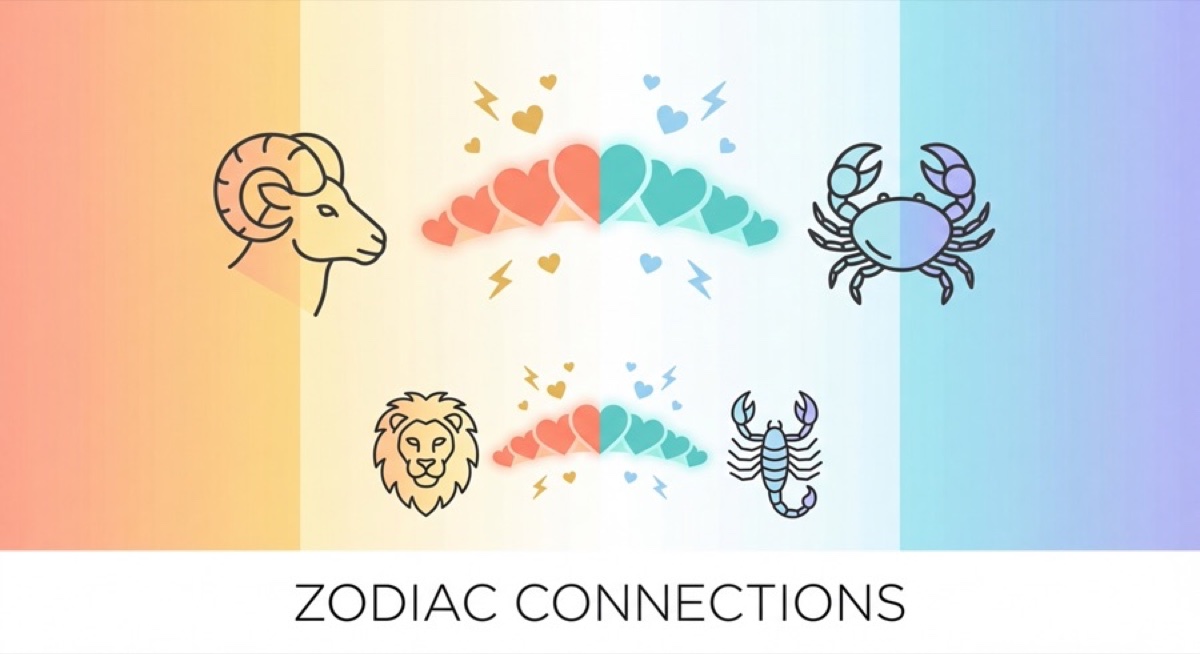
Why "Incompatible" Pairings Often Succeed
Compatibility in astrology describes tendencies, not fates. Two charts that have significant tension — squares, oppositions in challenging placements, fundamentally different elemental orientations — describe areas where both partners will need to do conscious work. They don't describe whether those partners are capable of that work, or motivated to do it, or whether the attraction between them is strong enough to sustain it.
In practice, some of the most enduring relationships are between "incompatible" signs because the very differences that create tension also create complementarity. One partner provides what the other lacks. The friction generates growth that wouldn't be available in a more comfortable pairing. The relationship asks more of both people — and in asking more, produces more.
What separates the "incompatible" couples who thrive from those who don't is almost never the synastry. It's the willingness of both people to understand how their partner is different, to adapt their expectations accordingly, and to treat difference as interesting rather than threatening.
Aries and Cancer: When It Works
This is one of the classic "terrible" matches in pop astrology. Aries is blunt, fast, and needs independence; Cancer is sensitive, slow to trust, and deeply needs emotional security. On paper, Aries's directness will bruise Cancer, and Cancer's emotional intensity will drain Aries. And if neither partner does any work, that's exactly what happens.
When this pairing works, it's because Aries has developed some awareness of impact — they've learned that saying the true thing doesn't require maximum bluntness, and that Cancer's emotional nature is not weakness but depth. Cancer, in turn, has learned to name what they need directly rather than retreating and hoping Aries notices. The couples who survive this pairing are usually the ones where Aries softens slightly and Cancer becomes more direct.
The gift of this pairing, when it works: Aries learns to care for someone's feelings without losing their essential directness. Cancer learns to be more courageous and less passive in expressing their needs. Both partners come out of the relationship having grown in their most significant personal blind spots.
Scorpio and Aquarius: When It Works
Scorpio needs depth, loyalty, and emotional intensity. Aquarius needs freedom, intellectual connection, and emotional space. These requirements appear to be directly opposed. Scorpio's jealousy and possessiveness will feel controlling to Aquarius; Aquarius's detachment and independence will feel abandoning to Scorpio. These are real patterns in this pairing and shouldn't be minimised.
The Scorpio-Aquarius relationships that work share one crucial feature: both partners have done significant personal work on their respective shadows. Scorpio has addressed the insecurity beneath the possessiveness and learned to trust without surveilling. Aquarius has learned to offer emotional reassurance rather than treating Scorpio's needs as demands on their freedom. This doesn't happen automatically — it usually happens after some painful experiences within the relationship.
When this pairing genuinely works, it produces something rare: a relationship with both intellectual depth and emotional intensity. Scorpio gives Aquarius access to emotional truth they tend to avoid; Aquarius gives Scorpio perspective that lifts them out of emotional spirals. The relationship is hard-won and extremely strong because of it.
Virgo and Sagittarius: When It Works
Virgo notices everything; Sagittarius sees the big picture and considers details someone else's problem. Virgo needs order and follow-through; Sagittarius creates plans they may not finish. Virgo's inner critic meets Sagittarius's casual relationship to obligation and produces either chronic friction or, eventually, remarkable complementarity.
The couples in this pairing who last are usually the ones where Sagittarius has genuinely impressed Virgo with their intellectual range and their honesty — Virgo deeply respects truth-telling, and Sagittarius is among the most direct signs in the zodiac. Virgo, in turn, has learned to relax their need for everything to be organised and finished, discovering that Sagittarius's broader-strokes approach sometimes produces outcomes that careful Virgo planning would never have found.
This pairing is particularly strong when both partners have secure individual identities and don't need the other person to be their mirror. Sagittarius brings expansion; Virgo brings precision. A project — or a life — built on both is often exceptional.
The Pattern Across All "Difficult" Pairings
Looking across the challenging pairings that actually work, a consistent pattern emerges: the partners have each done work on the exact quality that their sign's most common dysfunction represents. Scorpio has worked on possessiveness. Aries has worked on impact. Virgo has worked on perfectionism. Cancer has worked on directness. When both people in a "difficult" pairing have genuinely developed past their sign's shadow material, the differences between them become features rather than bugs.
The second pattern is that successful "incompatible" couples have found shared values beneath their different styles. Aries and Cancer might differ entirely on how they express and process emotion, but share a genuine commitment to protecting the people they love. Scorpio and Aquarius might differ on emotional style, but share an intellectual seriousness and a disdain for superficiality. Shared values are the foundation that makes style differences navigable.
The practical takeaway: astrology compatibility is useful as a map of where the work will be, not as a verdict on whether the relationship is possible. If you're in a "difficult" pairing and finding it worthwhile, the question is not whether you're astrologically compatible but whether you both want to do the work. If the answer is yes, the chart is largely irrelevant.