Why Some Feelings Have No English Word
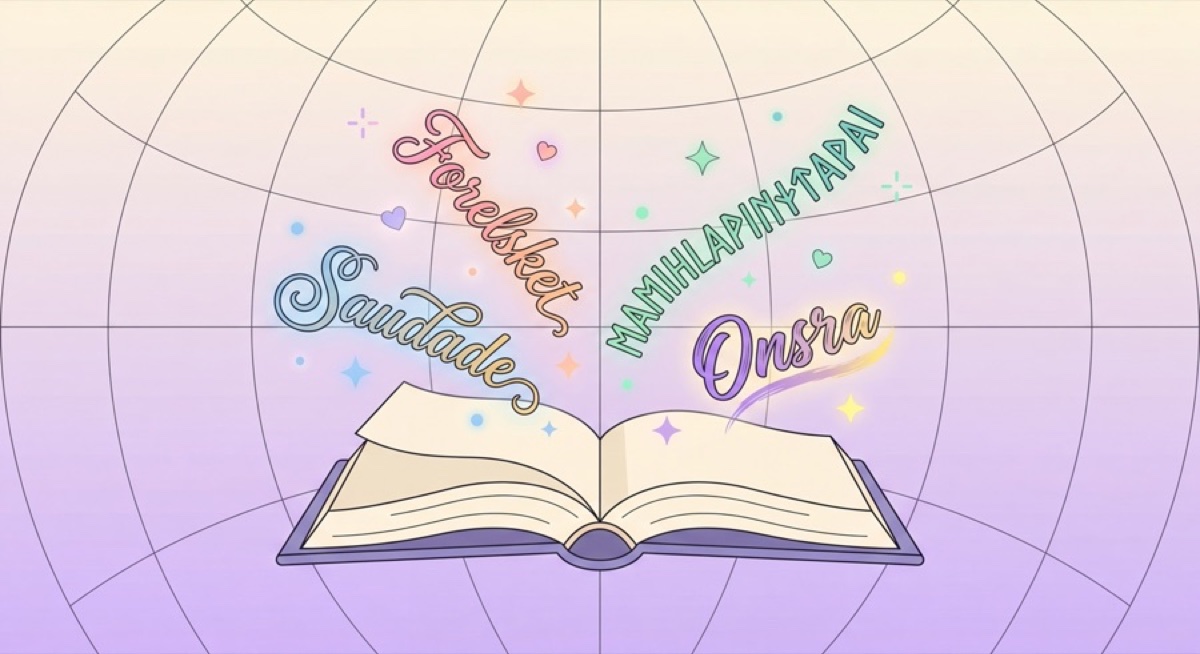
Language shapes perception. When a culture develops a word for something, it often means that the thing matters enough to be named — which in turn makes it easier to notice and discuss. English, despite its enormous vocabulary (one of the largest of any language), has conspicuous gaps in its emotional lexicon, particularly around love. The feelings are universal; the names are not. Exploring untranslatable love words from other languages is a way of discovering emotions you have already felt but never quite articulated.
The words below are not merely curiosities. They are invitations to a more granular emotional life. Once you know saudade, you will start noticing it in your own experience. Once you understand mamihlapinatapai, you will recognize it in the glances you exchange. Each of these words is a small act of naming — and naming a feeling, as any lover knows, gives you power over it and connection with others who feel the same thing.
Saudade, Forelsket, and the Language of Longing
Saudade (Portuguese, pronounced "sow-DAH-djeh") is perhaps the most famous untranslatable emotion in the world. It describes a deep, melancholy longing for someone or something beloved that is absent — a feeling that is neither quite grief nor quite nostalgia, but contains elements of both, along with a bittersweet awareness that the thing longed for may never return. Portuguese speakers claim that saudade cannot be fully translated because its emotional texture is specific to the Portuguese experience — centuries of maritime exploration, of people lost to sea, of distance and return. Whether that is true or not, the word captures something real and feels necessary the moment you learn it.
Forelsket (Norwegian/Danish) is the opposite of saudade: it names the euphoric rush of falling in love — that early, slightly unreal happiness when you are just beginning to love someone and the whole world seems luminous. English has "falling in love" as a phrase, but no single word for the state. Forelsket fills that gap. Similarly, Litost (Czech, coined by Milan Kundera) describes a state of torment caused by the sudden sight of one's own misery — often triggered in love by the awareness of one's inadequacy compared to one's beloved. Kundera called it "a state of agony and torment created by the sudden sight of one's own misery."
Ya'aburnee, Mamihlapinatapai, and the Intensity of Connection
Ya'aburnee (Arabic, يعبرني) — discussed in our Arabic love language article — deserves its place here as one of the most strikingly beautiful untranslatable expressions of love. "May you bury me" means: I love you so much I hope I die before you do, because living without you would be unbearable. It turns mortality into a declaration of love's magnitude. Said from parent to child, between lovers, between old friends, it is devastating in its sincerity.
Mamihlapinatapai (Yagán, a near-extinct language of Tierra del Fuego) is often cited as one of the most succinct words in the world: it describes the look shared between two people who both want something but neither wants to be the first to ask for it. In romantic context, it is the moment of mutual, unspoken, electric acknowledgment — the look before the first kiss, when both people know what is about to happen but neither has moved yet. The Yagán people, who lived in the southernmost tip of South America, encoded this specific human moment in a single word. That they needed a word for it tells you something about how universal it is.
Cafuné, Gigil, and Physical Tenderness
Cafuné (Brazilian Portuguese, pronounced "kah-foo-NEH") is the act of tenderly running your fingers through a loved one's hair. It is one of those words that, once encountered, makes you realize English has been leaving money on the table. English requires an entire descriptive phrase — "running my fingers through your hair" — for what Brazilian Portuguese handles in a single, beautiful word. Cafuné captures not just the action but the intimacy and tenderness of it, the particular gentleness of the gesture.
Gigil (Filipino/Tagalog) is the irresistible urge to squeeze or pinch something (or someone) that is unbearably cute or beloved — that overwhelming rush of affection that makes you want to compress the person you love into your arms until you can't tell where they end and you begin. Parents feel it for babies; lovers feel it for partners; it may be one of the most universal emotional experiences that English has never named. Basorexia — technically an English word but one that never caught on — describes the overwhelming urge to kiss someone. It deserves to be used more. And Foridelse (Danish) is the specific happiness you feel in the presence of someone you love. English has "joy" — Danish says this particular joy has a name.
Meraki, Hiraeth, and Love of Place and Self
Meraki (Greek, μεράκι) describes doing something with soul, creativity, and love — leaving a piece of yourself in the work. It is most often applied to creative acts, but in a romantic context, it describes the love you put into the gestures of a relationship: the meal cooked with complete attention, the message written with real care, the anniversary planned with heart. Meraki is what distinguishes an act of love from a mere obligation. When you cook for someone with meraki, they can taste it.
Hiraeth (Welsh) is a homesickness for a home you cannot return to, or perhaps never had — a grief for something lost that may be a person as much as a place. It is a cousin of saudade but with a specifically Welsh quality of longing, rooted in exile and displacement. In romantic terms, hiraeth can describe the feeling for a relationship that ended, or for a version of yourself that existed when you were most in love. Sehnsucht (German) covers similar territory: a deep longing, a profound yearning for something vague and beautiful and out of reach. C.S. Lewis wrote extensively about sehnsucht as a central human experience — the desire for something that the world and even love itself cannot quite satisfy.
Mono No Aware, Ubuntu, and Love in Its Widest Sense
Mono no aware (Japanese, 物の哀れ) — mentioned in our article on Japanese love language — is the bittersweet awareness of impermanence, the gentle sadness at the transience of beautiful things. Cherry blossoms fall precisely because they are brief; a relationship is precious precisely because it will not last forever. Mono no aware is the emotion you feel at the height of happiness when you suddenly know it will pass — and love it more fiercely because of that knowledge.
Ubuntu (Nguni Bantu languages, South Africa) — "I am because we are" — is not a word for romantic love specifically, but it speaks to love in its most expansive sense: the understanding that personhood itself is relational, that we exist through and for each other. In a romantic context, it captures something profound about what love does to the self: you become a different person in relationship, shaped and completed by the person you love. Tarab (Arabic) is the state of ecstatic, transcendent joy produced by music — but more broadly by beauty and emotion. At its peak, love produces tarab: an overwhelming, almost physical experience of feeling that transcends the ordinary. It is what the great love songs are reaching for.
Using These Words to Enrich Your Love Life
You do not need to speak another language fluently to benefit from its emotional vocabulary. Learning these words is enough to change how you notice and name your own feelings. The next time you run your fingers through a beloved person's hair, you will know: this is cafuné. The next time you feel that bittersweet awareness that a perfect moment is fleeting, you will recognize it as mono no aware. The next time you and someone exchange that charged look, you will understand: this is mamihlapinatapai. Naming the feeling does not diminish it — it amplifies it.
These untranslatable words are also wonderful gifts to share. Telling someone "there is a word for what I feel for you, and it is forelsket" is a form of intimacy and creativity that most love declarations lack. For more ways to express love that go beyond the ordinary, try the Love Poem Generator or the Love Letter Generator. For daily inspiration drawn from the world's wisdom about love, check the Love Fortune Cookie. And to see how these feelings are named across specific languages, explore the full hub on saying "I love you" in every language.