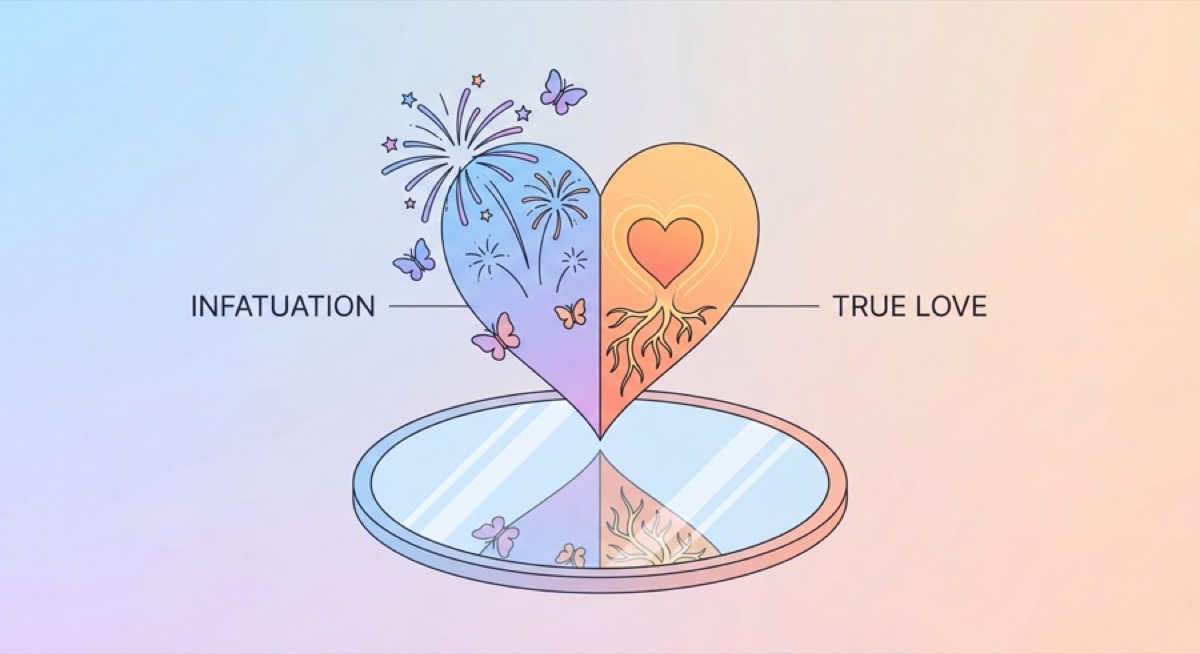
The Neuroscience of Infatuation
Infatuation — what scientists call limerence — is a neurological state, not just an emotion. When you are infatuated with someone, your brain is flooded with dopamine (producing euphoria and craving), norepinephrine (producing excitement, racing heart, and sleeplessness), and phenylethylamine (producing a natural amphetamine-like effect). Serotonin drops — which is why new infatuation produces the same obsessive thinking patterns as OCD. The person you are infatuated with occupies your mind for up to 85% of your waking hours in the peak of limerence. This is not metaphor; it has been measured.
This neurological storm is real and it is powerful — but it is also, by its nature, temporary. The brain cannot sustain this level of chemical intensity indefinitely. Infatuation typically peaks in the first three to eighteen months of a relationship and then shifts — either fading entirely (if the relationship lacked real compatibility), or deepening into something qualitatively different (love), or repeatedly cycling in people who move quickly from relationship to relationship chasing the infatuation high.
Signs You Are Infatuated, Not in Love
Infatuation has a recognizable signature. You think about this person constantly — not warmly, but obsessively. You idealise them: they seem perfect, or close to it, and you find yourself explaining away or not noticing their flaws. When they don't respond to a message quickly, you feel a spike of anxiety disproportionate to the situation. You feel dependent on their approval for your sense of wellbeing — their good mood lifts yours; their withdrawal devastates you. The relationship feels urgent and slightly desperate: you need them to feel a certain way about you.
Crucially, infatuation is more about how the other person makes you feel than about genuine interest in who they are. If you are honest with yourself, you know relatively little about their actual character, their values, their history — and you have not been particularly curious. What you are attached to is an image, a projection, a person-shaped vessel for your own longing. This is not a moral failing; it is simply what infatuation is. The question is whether it can develop into something more.
Signs You Are in Love
Love, as distinct from infatuation, has a different quality. It is warmer and less frantic. It tolerates — and even finds endearing — the real person rather than requiring the idealised one. You know their flaws, their difficult habits, their complicated history, and you choose them anyway — not despite these things but including them. The anxiety of infatuation has softened into a steadier security: you trust that this person will be there, and that trust is based on evidence rather than hope.
Love is also more other-directed than infatuation. You are genuinely interested in their wellbeing — not as a means to your own happiness, but as an end in itself. You want them to flourish even in ways that don't directly involve you. Their successes make you happy rather than threatening. When they are struggling, you want to help rather than finding it inconvenient. The relationship feels like a foundation rather than a fever.
The Timeline: How Long Does Infatuation Last?
Research suggests that limerence — intense infatuation — typically lasts between eighteen months and three years. After this point, the neurochemical cocktail changes: oxytocin and vasopressin (the bonding hormones associated with long-term attachment) become more dominant, producing a different kind of connection — less frantic, more secure, deeply comforting in a way that the infatuation phase never quite is.
This transition is the moment many relationships either consolidate into real partnership or fall apart. People who have been chasing the infatuation high can feel that the relationship has "gone flat" when actually what has happened is that it has matured. The absence of constant neurological fireworks can be mistaken for the absence of love. Understanding this transition — expecting it and valuing what comes after it — is one of the most important things a person can know about long-term relationships.
Can Infatuation Become Love?
Yes — and this is the ordinary path of most lasting relationships. Infatuation is not a problem to be solved; it is the beginning of a process. The question is what is underneath it. When the neurological storm subsides, is there a real person there that you genuinely know and like? Do you share values? Do you communicate well? Do you handle conflict in ways that are compatible? Is there mutual respect that is not contingent on the other person being perfect?
If the answers to these questions are yes, infatuation has a strong substrate to mature into. The couples who sustain love for decades are almost always people who moved through the infatuation phase and found, on the other side of it, a real partnership with a real person — and kept choosing that partnership even when it required effort rather than running effortlessly on neurochemistry.
Practical Questions to Ask Yourself
If you are unsure whether what you feel is love or infatuation, these questions can help clarify. Answer them honestly, without trying to reach a particular conclusion:
Do I know this person's actual values — not what I imagine them to be, but what I have seen them demonstrate? Do I feel comfortable being fully myself with them, including my less attractive qualities? When they are struggling or difficult, do I still want to be there — or do I find myself withdrawing? Do I think about their wellbeing and happiness as a genuine priority, or mainly as something that affects how they treat me? Can I imagine being with them if they changed significantly — lost a job, developed a health issue, became less exciting? Do I like who I am in this relationship?
These questions get at the foundations that love requires and that infatuation often lacks. For deeper conversation about where your relationship stands, our Questions for Couples tool offers prompts that surface this kind of honest reflection in a shared context.