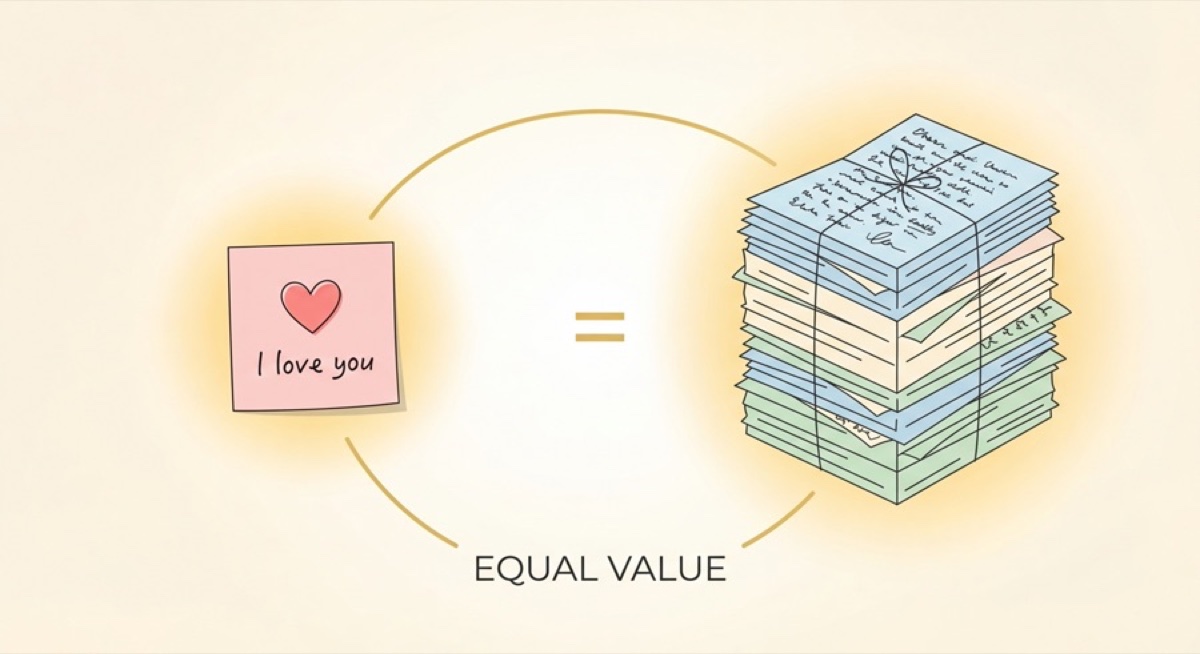
The Myth That Longer Means More Loving
There is an implicit cultural assumption that the length of a love letter correlates with the depth of feeling behind it. More words equals more love. This is not true, and believing it leads to two common mistakes: not writing at all when you cannot face a long letter, and padding a short, genuine feeling into something long enough to feel "worthy."
Johnny Cash wrote June Carter Cash some of the most celebrated lines in modern romantic correspondence in a letter that, read aloud, takes about two minutes. Plenty of long love letters are remembered by no one because length was doing the work that emotional truth should have done.
The right length for a love letter is the length that holds the reader's attention from first word to last without repetition or padding. Sometimes that is three sentences. Sometimes it is three pages. The question is not how long it is — it is whether every line earns its place.
When a Short Note Is the Right Choice
Short notes — three to seven sentences — are the right format in these situations:
- The everyday acknowledgement: You noticed something. You want them to know. A note tucked into a bag, left on the kitchen counter, taped to the bathroom mirror. These small acts of documented attention accumulate into something powerful over the course of a relationship.
- Before a difficult day: A note left when your partner is heading into something hard — a presentation, a difficult family event, a medical appointment. "I know today is hard. You are not alone in it. I will be here when you get back." Three sentences. Perfect.
- After something good: You want to mark a small moment that deserves marking. Not an occasion, just a moment. "Last night made me happy. I wanted to say so in writing."
- When the feeling is simple: Sometimes love is not complex. Sometimes it is just present and warm and requires no elaboration. A note that tries to be a letter when it only has a simple thing to say will sound overwritten. Let the simple thing be simple.
- As part of a habit: Short notes work best as a repeated practice. A note once a year is a gesture. A note once a month is a signal — it says: I think about you between occasions. I notice you in the ordinary time.
When a Long Letter Is the Right Choice
Long letters — anything over half a page — earn their length through occasion, complexity, or both. These are the moments that call for more:
- Significant milestones: Major anniversaries, significant birthdays, life transitions. These occasions deserve the full attention that a longer letter signals.
- Complex emotional terrain: Making up after a serious conflict, navigating a difficult period in the relationship, saying something that requires context and care to say fully. These cannot be reduced to three sentences without losing something essential.
- Long separation: When writing across weeks or months of long distance, a longer letter sustains the sense of presence and connection. It gives your partner something to return to across several readings.
- Something you have been building toward: The letter that contains something you have been meaning to say for a long time — a declaration, an acknowledgement, a truth that has been felt but not spoken. These require the space to approach properly.
For specific guidance on writing longer letters, see our complete love letter guide and our love letter examples page.
How to Write a Powerful Short Note
A short note has no room for warm-up. Every sentence must do real work. Here is the structure that consistently produces powerful short notes:
- Sentence 1: Name something specific. Not a declaration — a detail. Something observed, remembered, noticed. "I keep thinking about the way you laughed at dinner last Thursday."
- Sentence 2: Say what it made you feel or think. "It reminded me of why I fell for you — that completely unguarded version of you that I only see sometimes."
- Sentence 3: The declaration, now earned. "I love you. A lot. More than I say." After two specific sentences, the declaration lands with weight that it would not have had if it had come first.
Optional Sentence 4: A forward-facing gesture. "See you tonight." / "This has been in my pocket all day." / "No reply needed — I just wanted you to have it."
The key insight is that specificity does the work that length usually does in a longer letter. One specific detail, honestly described, earns a declaration of love more effectively than a paragraph of abstract sentiment.
The Power of Frequency Over Occasion
The most emotionally significant practice in long-term relationships is not the grand gesture — it is the small, consistent, repeated acknowledgement. A partner who writes a note on every anniversary is remembered as someone who marks occasions. A partner who leaves occasional notes in coat pockets, on kitchen counters, in books, "for no reason" — that partner is remembered as someone who thinks about you between occasions.
The difference matters. Being loved on occasions is warming. Being loved in the ordinary between-time is what changes the emotional texture of a relationship. Short notes are the primary vehicle for that kind of love.
Consider a simple practice: once every two to three weeks, write a note of three to five sentences. It does not need to be inspired or elaborate. It just needs to name something true about how you feel, right now, for this specific person. The cumulative effect of this practice across a year will be more significant than any single grand letter.
20 Powerful Short Love Notes You Can Use Now
These are complete short notes, ready to adapt or use:
- "I saw something today that made me think of you. I can't wait to tell you about it tonight. I love you."
- "You don't know this, but I looked at you for a long time this morning while you were still asleep. I couldn't believe my luck."
- "Thank you for last night. Not for anything in particular. Just for being the person you are to be with."
- "I've been thinking about you all day. Not dramatically — just warmly, the way you think about something good that's waiting for you."
- "I know this week has been hard for you. I see it. You're doing better than you think."
- "You made me laugh three times before 9am this morning. I just wanted you to know that I noticed."
- "No reason for this note. Just that I love you and sometimes that requires paper."
- "I found this in my pocket and it made me think: I should say it more. So: I love you. More than I usually say."
- "You are my favourite part of every day. Even the bad ones."
- "I've been keeping a list of things to tell you. This is a small one from the list."
- "Happy Tuesday. I like sharing my Tuesdays with you."
- "I keep noticing things about you that I've never noticed before. It surprises me that I'm still learning you."
- "Go and have a good day. I'll be here when it's over."
- "You looked beautiful this morning. I meant to say so and then got distracted. So: you looked beautiful this morning."
- "Thank you for being patient with me lately. I know I haven't been easy. I love you."
- "I want you to know that my favourite thing about my life right now is you."
- "One day I'll find the words to tell you properly how much this means. Until then: this note."
- "I saved you something to eat. It's in the fridge. It's small. So is this note. Both are because I was thinking about you."
- "Counting down to seeing you. Doing a terrible job of not thinking about it."
- "Still choosing you. Every day. In case you needed to hear it today."
For longer-form inspiration, explore our full love letter examples or use the AI Love Letter Generator for a personalised draft. For immediate short messages, see our Romantic Text Messages collection.
Combining Both: Building a Love Letter Practice
The most effective romantic communication is not a single format but a portfolio: short notes for frequency and dailiness, long letters for depth and occasion. Together they create something neither can produce alone — a continuous record of a relationship, maintained in writing, that spans the ordinary and the significant in equal measure.
Consider this framework: short notes every two to three weeks, a longer letter two to four times a year (not necessarily on major occasions — some of the most powerful longer letters are "for no reason, just now"). Over a year, your partner receives ten to twelve short notes and three or four longer letters. Over five years, that is fifty to sixty notes and fifteen to twenty letters. That is a body of work. A library of love.
Start wherever you are. One note, written today, is more valuable than a perfect practice you plan to begin later. If you want help with a longer letter, see our complete writing guide or try the AI Love Letter Generator for a starting point. If you want to say something right now, see our Romantic Text Messages for immediate options.