What Makes a Language Romantic?
Before ranking languages by romance, we need to define what we mean — because "romantic" is doing a lot of work. There are at least three distinct senses: phonetic romanticism (the language simply sounds beautiful and pleasing to the ear), cultural romanticism (the culture associated with the language has a strong romantic tradition), and linguistic romanticism (the language has unusually rich vocabulary and expressive capacity for love and emotion). The most romantic languages tend to score highly on all three measures, though not always equally.
There is also a fourth factor that people rarely name but everyone feels: the prestige of a romantic tradition. A language associated with great love poetry, great love songs, or a culture widely perceived as romantic gets a reputational boost that is hard to separate from objective assessment. French benefits enormously from this — its reputation as the language of romance is self-reinforcing. Once you believe French is romantic, you hear it as romantic, which reinforces the belief. With that caveat noted, let us make our case.
First Place: The Great Debate — French vs. Italian
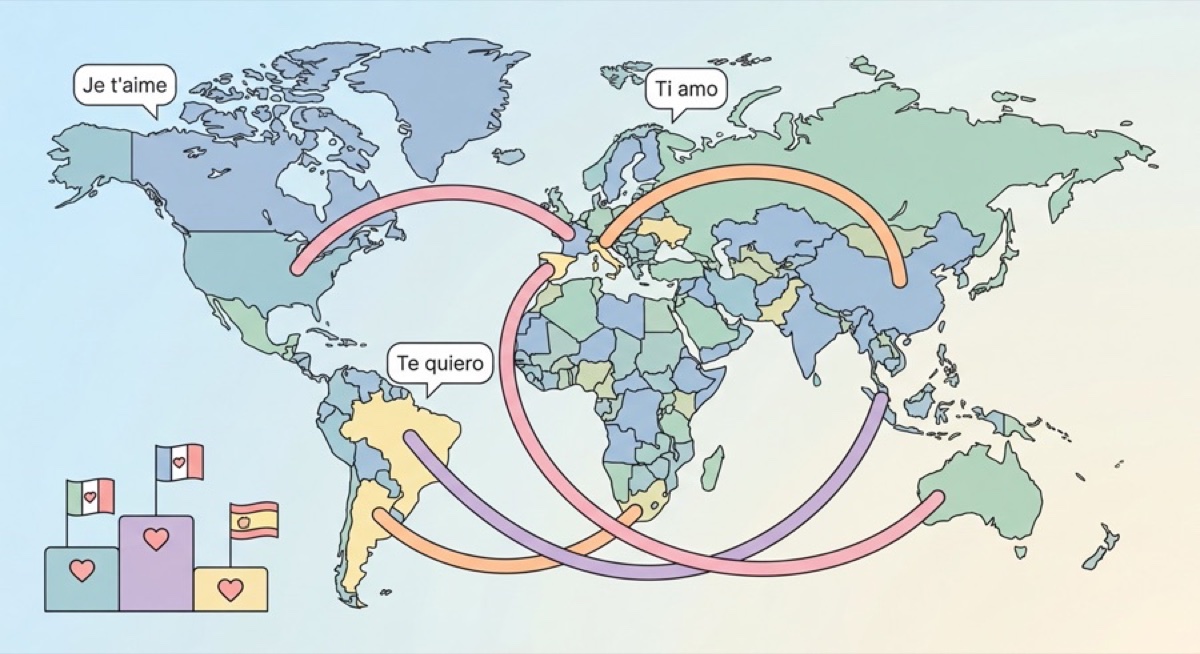
The competition for the world's most romantic language comes down, ultimately, to French and Italian — and reasonable people disagree passionately. French has the stronger global reputation, the more celebrated literary tradition of romantic philosophy, and the most powerful prestige effect. When people anywhere in the world imagine the sound of romance, they often hear French: its nasal vowels, its liaisons, its flowing musicality. Je t'aime has been borrowed into a hundred other cultures as a symbol of romance itself.
But Italian has the stronger phonetic case. Its open vowels, its consistent musicality, its freedom from the nasal tones that some non-French speakers find less immediately appealing — Italian was called by many composers "the singing language" and was for centuries the preferred language of opera precisely because it sounded best when sung. Ti amo lands with a clarity and warmth that je t'aime does not quite match for many ears. The Italian culture of passion, expressiveness, and aesthetic investment in life also makes a compelling cultural case. Our verdict: French is the more romantically prestigious language; Italian is the more phonetically beautiful one. Explore them both in our articles on French and Italian love language.
Spanish and Portuguese: The Passion Contenders
Spanish deserves serious contention for the top spot, if only for sheer scale: with 500 million native speakers, it is the language in which more people actually declare love than any other on this list. The Spanish-speaking world has produced some of the greatest love poetry (Neruda), the most listened-to love songs (boleros, Latin pop), and a culture of romantic expressiveness that is difficult to match. The distinction between te amo and te quiero gives Spanish an emotional precision around love that neither French nor Italian possesses. Read more in our full article on saying "I love you" in Spanish.
Portuguese — particularly Brazilian Portuguese — makes a surprising and strong case that is often overlooked. Portuguese has saudade, perhaps the most famous untranslatable emotional word in the world (see our article on untranslatable words for love), and cafuné, and a musical tradition — bossa nova, fado — of devastating romantic beauty. The Portuguese fado tradition, listed by UNESCO as an intangible cultural heritage, is essentially an entire musical genre built around the ache of love and longing. Brazilian Portuguese adds rhythmic warmth to the equation. Portuguese may be the most underrated romantic language in the world.
The Surprising Contenders: Arabic, Persian, and Urdu
The Romance languages dominate the public imagination of romantic language, but a strong case can be made for Arabic, Persian (Farsi), and Urdu — three languages with literary traditions of romantic poetry that predate and rival anything Europe has produced. Arabic's thirty words for love (detailed in our article on Arabic love language), its poetic tradition stretching back 1,500 years, and its capacity for elaborate romantic expression give it a serious claim. The Sufi love poetry tradition, which spans Arabic and Persian, represents some of the most intense and beautiful romantic writing in world literature.
Persian (Farsi) gave the world Rumi and Hafez — poets whose love verses have been translated into hundreds of languages and continue to be quoted at weddings and funerals worldwide. Urdu, the primary language of Pakistani poetry and one of South Asia's great literary languages, has a tradition of ghazal poetry that takes love as its central and almost exclusive subject. Urdu speakers will tell you, with genuine passion, that Urdu is the language of love — that its sounds, its script, and its literary tradition make it uniquely suited to the expression of longing and desire. They are not wrong.
Least Romantic? The Case Against (and For) German and Japanese
German and Japanese are often cited as the least romantic languages — unfairly, we would argue. German's reputation for emotional reserve and compound nouns does not do justice to its extraordinary literary and musical tradition of romantic expression, or to the genuine emotional depth that lies beneath the cultural surface. Ich liebe dich may be said less often than its equivalents elsewhere, but when it is said, it lands with undeniable force. The German romantic literature of the late 18th and 19th centuries was among the most emotionally intense in European history. Read the full case in our article on German love language.
Japanese is perhaps the most interesting case of all: a language whose most powerful love declaration (aishiteru) is almost never spoken, and whose romantic culture privileges non-verbal expression, restraint, and action over declaration. This does not make Japanese less romantic — it makes it differently romantic. The Japanese concept of mono no aware — the bittersweet awareness of impermanence — gives Japanese love a quality that Italian passion, for all its beauty, does not quite capture: the awareness that this moment, this person, this feeling, will not last forever, and the decision to love them fully anyway. That may be the most romantic thing of all. More in our article on Japanese love language.
The Science of Phonetic Romance: Why Some Languages Sound Like Love
Linguists and psychologists have studied what makes languages sound beautiful or romantic to listeners, and the results are interesting. Languages with high vowel content, flowing phonetic transitions, and minimal harsh consonants tend to be rated as more beautiful and more romantic by listeners — which partly explains the Romance languages' reputation. Italian's approximately 45% vowel content (one of the highest of any major language) versus English's roughly 35% gives it a sonic richness that is measurable.
Melodic intonation — the sing-song quality of some languages — also contributes to perceived romance. Mandarin Chinese's tonal system gives it a musical quality that many find beautiful. Swedish and Norwegian have a characteristic lilt that many non-Scandinavian listeners find enchanting. But phonetics is only part of the story: a beautiful-sounding phrase in a language whose cultural associations are not romantic will still not carry romantic charge. Sound and culture work together. The most romantically effective language is ultimately the one spoken by the person you love — and in their voice, any language becomes the most beautiful in the world. Use our Say "I Love You" translator to hear love declared in 60+ languages and judge for yourself.
Our Final Ranking — With All Its Caveats
With all the above in mind, here is our ranking of the most romantic languages — acknowledging that "romantic" is genuinely multidimensional and that any ranking is partly subjective: 1. French — phonetically beautiful, culturally prestigious, philosophically rich. 2. Italian — phonetically the most beautiful, culturally passionate, operatically expressive. 3. Portuguese — emotionally rich, musically magnificent, criminally underrated. 4. Spanish — vast, passionate, poetically extraordinary. 5. Urdu/Persian — the great overlooked contenders, with literary traditions of staggering depth. 6. Arabic — thirty words for love and a poetic tradition that humbles the rest. 7. Japanese — quiet, deep, and in its own way the most romantic of all.
The best thing you can do with this ranking is argue with it. Ask which language you find most beautiful and why. Consider what "romantic" means to you personally. And then, if you are ready to declare love in any of them, our Say "I Love You" translator is your starting point. For the full exploration of love across languages, return to our hub on how to say "I love you" in every language. Or let the Love Fortune Cookie give you today's romantic wisdom — no language required.