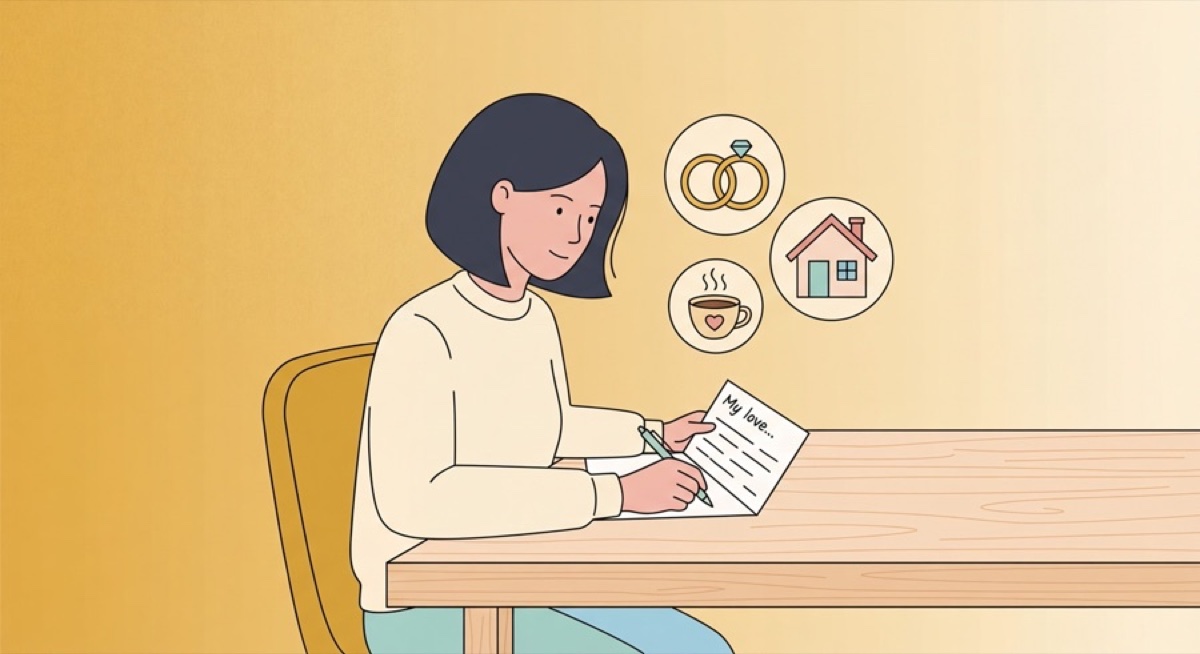
What Men in Long-Term Relationships Actually Want to Hear
This is not about generalising men — it is about understanding the particular emotional dynamic of long-term partnership. Research into what partners in established relationships report feeling most appreciated for reveals consistent themes: being seen as capable and competent, feeling that their presence matters (not just their contribution), and hearing that they are still chosen — not just settled for.
Many husbands, particularly those who grew up in households where emotional expression was not modelled, are more moved by letters that are concrete and specific than by abstract declarations of love. "You are a wonderful husband" is warming but thin. "The way you handled the situation with my dad in January — you were patient when I wasn't, and you didn't make me feel guilty about it afterwards" is evidence. It proves you noticed. It proves you remember.
The subtext your husband needs to receive: you are not invisible to me. That subtext is delivered most powerfully through specificity.
Mining Your Shared History for Material
The richest material for a letter to a long-term partner is always the accumulated, private, unremarkable-seeming moments that define a shared life. These are the moments that no one else has access to. They are your most powerful raw material precisely because they are exclusive.
Ask yourself these questions and write down the first thing that comes to mind:
- What is a moment in the past year where I noticed him doing something quietly good — something he didn't announce or seek credit for?
- What is a habit or quality of his that I have stopped noticing but would miss immediately if it were gone?
- What is one thing he has done for me that I never properly thanked him for?
- How has he changed in the years I have known him, and what do I admire about that change?
- What does the ordinary texture of life with him feel like, and what is one specific image that captures it?
These answers are the raw material of a letter that will matter to him far more than a beautifully written but generic declaration of love.
Tone: Finding the Right Register for Your Relationship
One of the gifts of a long marriage is that you know exactly what emotional register lands for your specific person. Some husbands will be more moved by humour — a letter that acknowledges the absurdities of your shared life with genuine warmth, and lands the feeling underneath the laughter. Others respond better to directness: clear, unadorned statements of love and appreciation.
Resist the temptation to write the letter you think a love letter should sound like, and write the letter that sounds like you. Your husband has heard your voice for years. He will notice immediately if the letter sounds like it was written by someone else — and it will create a tiny but real distance between him and the words.
If your relationship has a lot of humour in it, put humour in the letter. If you are private and economical with emotion in your daily life, a letter that suddenly reaches for poetry might feel strange to both of you. Write in the dialect of your relationship.
What to Include Beyond "I Love You"
A letter that only contains declarations of love, however warm, misses an opportunity. Consider weaving in:
- Gratitude for something specific: Not "thank you for everything you do" but "thank you for the fact that you make the coffee before I am awake, every single morning, without being asked."
- Admiration for a character quality: Something you have observed over time — his patience, his integrity in a specific situation, the way he treats people he does not need to be kind to.
- A vision of the future: One concrete image of something you are looking forward to experiencing together. This does not need to be grand — it can be a holiday, a season, a version of your lives when the current hard thing has passed.
- Something you have never said: Every long relationship has things that are felt but not spoken. A love letter is the right place to finally say one of them.
A Short Example Letter
I have been meaning to write this for a while, and I keep waiting for a reason — an anniversary, a birthday, some occasion that would make it make sense. I have decided not to wait for a reason. You are the reason.
I want to tell you something I have been thinking about. A few months ago, when I was really struggling with the job situation, you never once made me feel like a burden. You asked the right questions. You knew when not to ask questions at all. I don't think I told you at the time how much that meant. I'm telling you now.
I love the life we have built. I love that it is a little messy and a little ordinary and entirely ours. I love that you still make me laugh. I love that you are the first person I want to call when something happens — good or bad, without exception.
You are not just who I love. You are who I like. Every day.
All of it —
[Your name]
For more complete examples, visit our love letter examples page. For help drafting your own letter, try our AI Love Letter Generator.
When and How to Deliver It
Delivery matters almost as much as content. A letter that is handed over awkwardly during dinner, or emailed with the subject line "something I wrote," loses some of its impact before it is even read. Think about how the moment of discovery will feel to him.
Some effective options: tucked into his bag before a trip or a hard day at work; left on his pillow; presented at a quiet moment you have created intentionally; sent as a proper letter in an envelope through actual post, which creates a ritual of opening that email cannot replicate.
Give him space to read it without you watching him. Some people need to process in private. You can talk about it afterwards — or not. Let him decide.
If you are weighing handwritten versus digital, read our article on handwritten vs. digital love letters for guidance on which format fits your situation.
Making It a Practice, Not a One-Off
The most powerful thing about a love letter in a long-term relationship is not any single letter — it is the practice of writing them. A relationship in which both partners occasionally put their feelings into words, deliberately and in writing, develops a different kind of intimacy than one where love is expressed only through action or verbal habit.
Consider writing even a short note three or four times a year — not only on obvious occasions. The unexpected letter, the one that arrives for no particular reason, is often the one that is kept longest. You can start small: even a short love note of three sentences, written by hand, will be noticed and remembered.
Need a romantic text for right now, without the ceremony of a full letter? See our collection of romantic text messages for quick but genuine options.