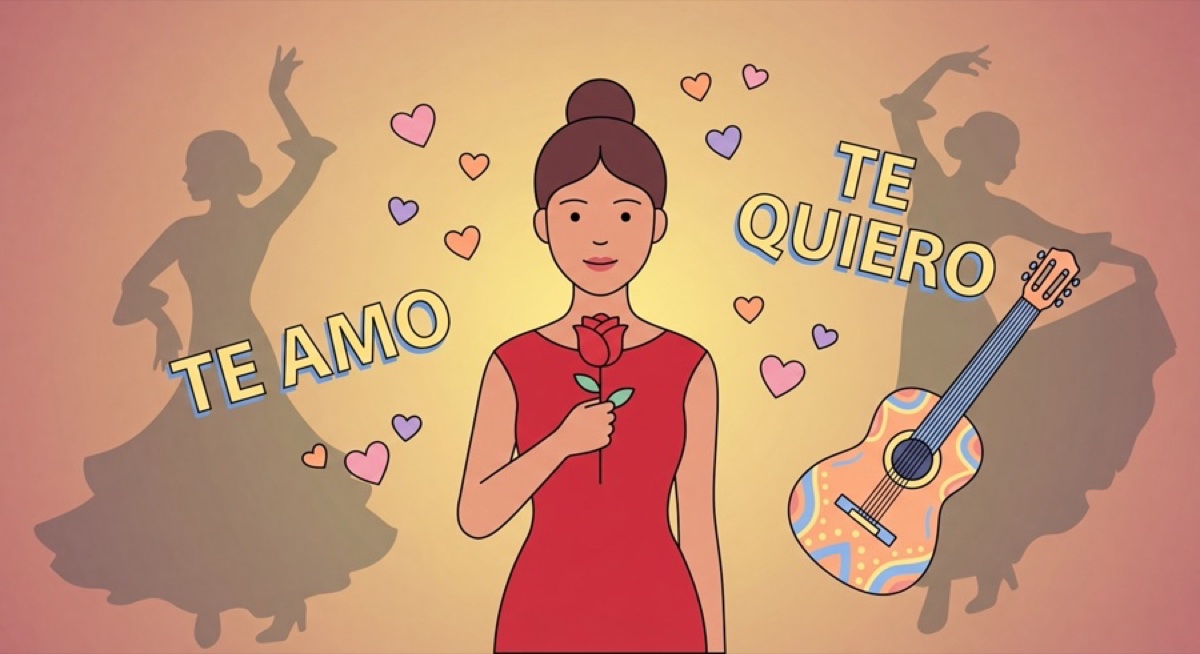
Te Amo vs. Te Quiero: The Difference That Matters
The most important thing to understand about saying "I love you" in Spanish is that there is no single translation. Te amo and te quiero are both used to express love, but they operate at different emotional altitudes. Te amo — literally "I love you" — is the heavier declaration. It carries romantic gravity, the kind of weight you feel when you say it for the first time or when you mean it with your whole life. In most Spanish-speaking cultures, te amo is reserved for a romantic partner, and saying it prematurely can feel alarming rather than sweet.
Te quiero, by contrast, translates literally as "I want you" — but its everyday meaning is closer to "I care for you deeply" or "I love you" in the warm, comfortable sense. It is appropriate for close friends, family members, and romantic partners alike. Many couples in Spain and Latin America say te quiero every day and reserve te amo for profound moments: a proposal, a reconciliation, a whispered exchange in the dark. Understanding this distinction can save you from either under-declaring or overwhelming the person you care about.
Regional Variations Across the Spanish-Speaking World
Spanish is spoken natively by over 500 million people across 20 countries, and while te amo and te quiero are understood everywhere, local flavors abound. In Mexico, you might hear te adoro (I adore you) as a tender intensifier, while in Argentina, the Italian-influenced culture has given Spanish there a musical lilt and an even more expressive romantic vocabulary. In Spain itself, the Castilian tradition blends a certain emotional directness with an appreciation for poetry — Spain produced Lorca, after all.
In the Caribbean Spanish of Cuba, Puerto Rico, and the Dominican Republic, love expressions tend to be more exuberant and physically expressive, folded into a culture where music, dance, and touch are themselves languages. In Colombia and Venezuela, terms of endearment pile up richly: mi amor (my love), mi vida (my life), mi cielo (my sky). These are not hyperbole — they are the ordinary currency of affection. Use our Say "I Love You" translator to hear these phrases spoken aloud in authentic Spanish.
Pronunciation Guide: Saying It Right
Spanish pronunciation is remarkably consistent — once you learn the rules, they hold. Te amo is pronounced "teh AH-mo," with the stress on the first syllable of amo. The t in Spanish is softer than in English, produced with the tongue touching the back of the upper teeth rather than the ridge behind them. Te quiero is pronounced "teh KYEH-ro," with the qu making a hard K sound, never a KW. The double rr in quiero is a single R in most dialects — a soft, single tap of the tongue.
If you want to go further, try learning a full romantic phrase: Eres el amor de mi vida means "You are the love of my life," and it is pronounced "EH-res el ah-MOR deh mee BEE-da." For daily practice and audio pronunciation, our Say "I Love You" translator is an excellent tool. And if you want to put your feelings into writing, the Love Letter Generator can help you craft something truly personal.
The Role of Romantic Culture in Spanish-Speaking Countries
To understand Spanish love language, you have to understand that romance in the Spanish-speaking world is rarely just private. It is performed, celebrated, witnessed. A young man serenading his beloved beneath her window — the serenata — is not a cliché from old movies; it is still practiced in parts of Mexico and Central America. In Spain, the tradition of rondalla involved groups of musicians accompanying a suitor's declaration. Love, in these cultures, is something you show to the world.
This communal dimension of romance means that public displays of affection are generally more accepted and even expected in many Latin cultures than in, say, Northern Europe or East Asia. Couples hold hands, embrace, and use endearments openly. Families are deeply involved in romantic relationships, and a partner's acceptance by the family is its own form of love declaration. This is a culture where love is loud — and proud of it.
Spanish Love Phrases Beyond "I Love You"
Once you have mastered the basics, a richer vocabulary awaits. Me tienes loco/loca — "you make me crazy" — is a passionate, slightly exasperated declaration of desire. No puedo vivir sin ti means "I cannot live without you," and while it sounds dramatic, in Spanish it lands with heartfelt sincerity rather than melodrama. Eres mi media naranja translates as "you are my half orange" — the Spanish equivalent of "you complete me," rooted in the charming belief that every person has a perfect matching half.
Spanish also has a lovely tradition of diminutives that soften and sweeten: calling someone mi amor becomes mi amorcito (my little love), and cariño (affection, darling) can become cariñito. These small linguistic moves signal intimacy and tenderness. For more inspiration, explore our Love Quotes collection, which includes beautiful phrases from Spanish-language literature and poetry. You might also enjoy the Love Poem Generator to craft something uniquely yours.
Spanish in Literature and Song: Love's Greatest Language?
Spanish has produced some of the world's greatest love poetry. Pablo Neruda's "Twenty Love Poems and a Song of Despair" is perhaps the most famous collection of love verse in any language. His lines — Puedo escribir los versos más tristes esta noche, "Tonight I can write the saddest lines" — have been read at millions of weddings and breakups alike. Federico García Lorca brought duende, that dark and vital life-force, into his love poetry, making it dangerous and alive.
In music, the bolero tradition — from Cuba, beloved across Latin America — gave the world slow, aching declarations of love that millions know by heart. Songs like Bésame Mucho ("Kiss me much") became international anthems of longing. Modern Latin pop and reggaeton continue this tradition, proving that Spanish-language love songs need no translation to reach the heart. If Spanish has a rival for the most romantically productive language in history, it has not made its case strongly enough.
How to Use These Phrases Authentically
The best way to use Spanish love phrases is to understand the cultural weight behind them and deploy them accordingly. Say te amo when you mean it fully — not as a casual sign-off, but as a declaration you are willing to stand behind. Use te quiero freely with people you genuinely care about, knowing it communicates warmth without demanding a response in kind. And learn at least one or two terms of endearment from the region of your partner's heritage — that specificity is its own form of devotion.
If you are learning Spanish partly for romantic reasons, you are in good company — it is one of the most popular languages for couples to learn together. Start with our Say "I Love You" translator for pronunciation, browse the Love Quotes for inspiration, and keep exploring the full hub on saying "I love you" across languages to see how Spanish fits into the beautiful, global picture of human love.