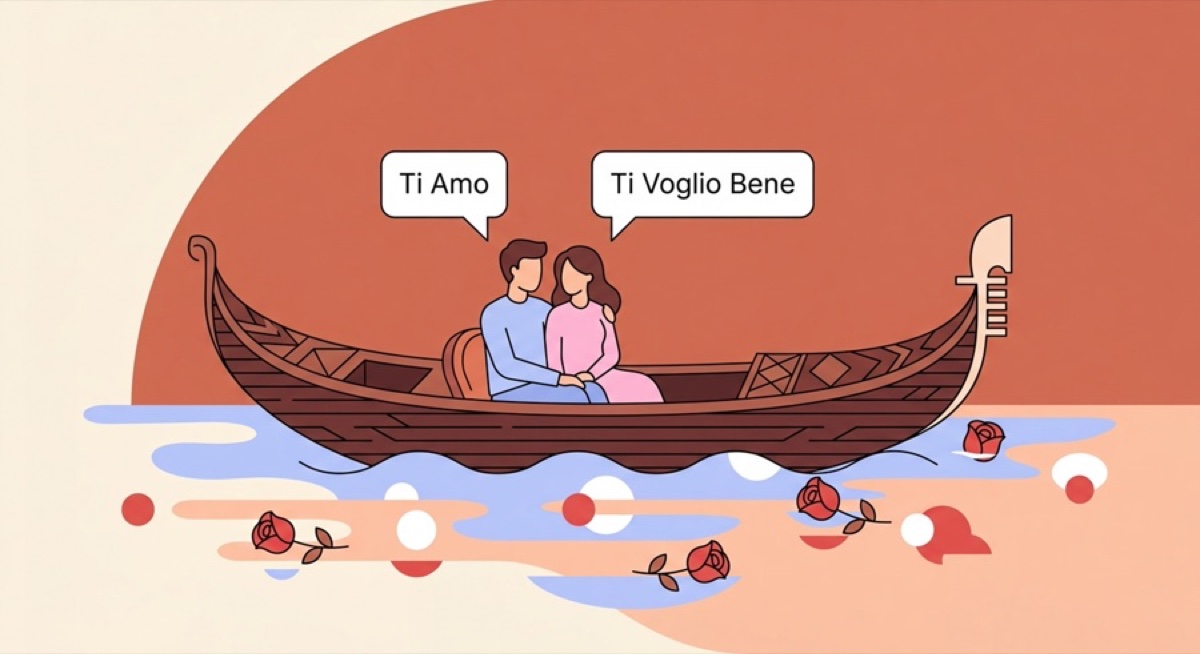
Ti Amo vs. Ti Voglio Bene: Italy's Essential Distinction
Ti amo — "I love you" — is the romantic declaration, said to a lover with full intention. It is unambiguous, passionate, and not used lightly outside of romantic relationships. Saying ti amo to a friend would be awkward; saying it to a romantic partner at the right moment is one of life's great gestures. Ti amo carries the force of romantic commitment — it is the phrase of lovers, not companions.
Ti voglio bene translates literally as "I want good for you" and is one of Italian's most beautiful linguistic inventions. It expresses deep love — the kind you feel for family, close friends, and partners in their domestic, everyday dimension — without the specifically romantic charge of ti amo. A mother says ti voglio bene to her child. Old friends who have known each other for thirty years say it at the end of phone calls. A couple might say ti amo in a passionate moment and ti voglio bene while saying goodnight — and both are true, and both are needed. Italian has given this distinction a name that English cannot.
The Sound of Italian Love: Pronunciation and Musicality
Ti amo is pronounced "tee AH-mo" — clean, open vowels, no diphthongs, nothing to stumble over. The Italian language's consistent vowel sounds and double consonants give it a musical quality that makes love declarations land with particular sweetness. Ti voglio bene is pronounced "tee VOL-yo BEH-neh" — the gl combination creates a liquid sound (like "ly") that is characteristic of Italian and gives the phrase its gentle, rolling quality.
Italian pronunciation is governed by rules that hold almost without exception, which means that with a little practice, you can sound convincing. The key is to open the vowels fully and not swallow the final syllable — Italian words almost never end in consonants, and those trailing vowels carry the music. Our Say "I Love You" translator lets you hear these phrases spoken by native speakers, which is invaluable for capturing the rhythm and feeling of the language. A phrase in Italian that is rhythmically wrong loses much of its power.
Italian Terms of Endearment: Amore, Tesoro, and Cuore
Italian has a magnificent array of terms of endearment, many of which have crossed into other languages because they simply sound too good to stay confined to Italian. Amore (love) is the universal one — used alone as a form of address, it is the Italian equivalent of "darling" or "sweetheart." Amore mio (my love) adds the possessive and intensifies the warmth. Tesoro (treasure) and tesoro mio (my treasure) are common and affectionate. Cuore mio (my heart) speaks to the centrality of the beloved.
The Italian language's love of diminutives — adding -ino/-ina or -etto/-etta to make things small and therefore adorable — plays beautifully in endearments. Amorino (little love) is used for children and, tenderly, for romantic partners. Cuoricino (little heart) achieves the same effect. There are also regional variations: in the south, picciridda (Sicilian dialect for little girl) is used affectionately, while in the north, Germanic influences have left different marks on endearment traditions. Italian love language is as regionally varied as Italian food.
The Culture of Italian Passion: La Dolce Vita and Love
Italian culture has built its international reputation partly on a relationship with pleasure and beauty that most other cultures can only admire. La dolce vita — the sweet life — is not just a Fellini film; it is a genuine cultural value, a philosophy that beautiful things, including love, are worth pursuing and celebrating. The Italian aesthetic sense permeates romantic life: the effort made in dressing well, the care taken with food preparation and presentation, the investment in creating atmosphere — all of these are, in Italian culture, forms of love.
Physical expressiveness comes naturally in Italian culture. Italians touch each other often — a hand on an arm during conversation, cheek kisses in greeting, embraces between friends. This tactile comfort means that physical affection between romantic partners is natural and unremarkable. Love is not just said; it is displayed through the whole body and through the environment one creates. A beautifully set dinner table with candles and wine is an Italian love declaration as surely as any words.
Italy's Literary and Operatic Legacy of Love
Dante wrote the Divine Comedy — the greatest poem in any language, according to many — as an extended act of love for Beatrice, a woman he saw twice and never possessed. Petrarch spent a lifetime writing sonnets for Laura, a woman who may or may not have returned his feelings. These men were not unusual in Italian culture; they were representative of a tradition that treats love as worthy of one's greatest artistic efforts. Italian literature is, in significant part, a literature of love.
Italian opera took this literary passion and added music, volume, and gesture. Opera — invented in Italy in the late 16th century — is fundamentally a love art form: grand, melodramatic, unashamed of its own intensity. The word operatic has become a synonym for "excessively emotional" in English, but in Italian culture, operatic emotion is not excessive — it is appropriately calibrated to the magnitude of love. O sole mio, Nessun Dorma, the arias of Verdi and Puccini — these are Italian love letters written for full orchestra. For beautiful love quotes from the Italian tradition, browse our Love Quotes collection.
Regional Romance: Love Across Italy's Diverse Landscape
Italy was only unified as a nation in 1861, and its regions retain distinct cultures, languages, and characters that extend into romantic life. The passionate expressiveness associated with southern Italy — particularly Sicily, Naples, and Calabria — stands in notable contrast to the cooler, more reserved emotional style of the north. Venetians and Milanese tend toward more measured emotional expression; Neapolitans are famous for the warmth and intensity of their interpersonal style. These are generalizations, but they point to a real internal diversity within "Italian" romance culture.
Regional dialects also carry their own love vocabularies. Sicilian, Neapolitan, Venetian, and Roman dialects each have their own terms of endearment and love expressions that may be incomprehensible to speakers of other regional varieties. This linguistic richness is one of Italy's great cultural treasures — and it means that "how Italians say I love you" is not one answer but many. For all of these, our Say "I Love You" translator captures the standard Italian forms and helps with pronunciation.
Putting Italian Love Language Into Practice
The best way to honor Italian love language is to embrace its qualities: generosity, expressiveness, aesthetic attention, and sincerity. If you are using Italian phrases with an Italian speaker, do not hold back — understatement is not an Italian virtue in romantic contexts. Say ti amo with your whole voice. Use ti voglio bene freely with those you cherish. Call people amore without embarrassment.
If you want to go further, try writing a love note using the Love Letter Generator, or create something poetic with the Love Poem Generator. Italian is one of the best languages in which to receive a love poem — and one of the best in which to give one. For the complete landscape of love across languages, return to our hub on how to say "I love you" in every language, or explore how Italian compares in our ranking of the most romantic languages in the world.