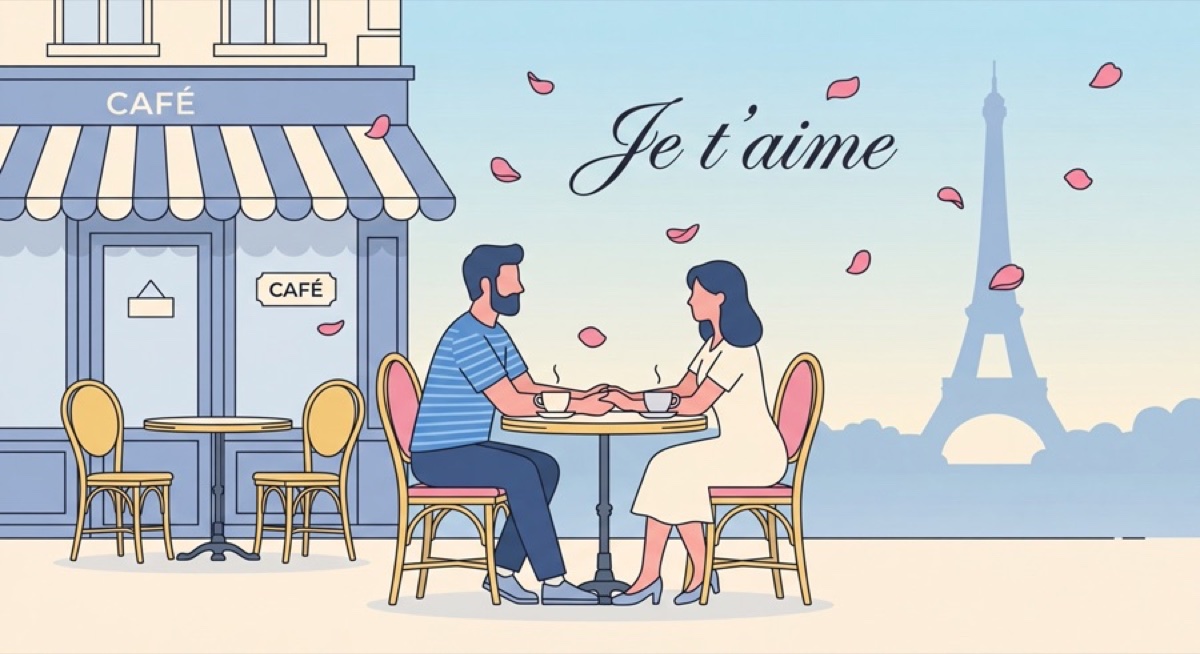
Je T'aime vs. Je T'adore: Knowing the Difference
Je t'aime is the foundational declaration: "I love you," spoken directly, romantically, with full intention. Unlike in Spanish, French does not offer a separate lighter-weight alternative for friends and family — je t'aime is unambiguously romantic when said to a partner, and therefore carries real weight. Saying it too early can unsettle a French person; saying it at the right moment is considered deeply meaningful.
Je t'adore translates as "I adore you" — it is warm, affectionate, and can be used with people you are not romantically involved with. You might tell a dear friend, a parent, or a beloved child je t'adore without any romantic implication. For a romantic partner, it can be used alongside je t'aime as an intensifier or a tender variation. The distinction is subtle but real: je t'aime is love; je t'adore is enchantment. The French, who take these distinctions seriously, would say one should ideally feel both.
The French Approach to Romance: Quality Over Quantity
One of the most striking things about French romantic culture is its emphasis on subtlety and earned intimacy. The French are famously not given to gushing — a lover who declares undying devotion on a third date might be met with polite skepticism rather than swept-off-feet delight. This is not coldness; it is a deep cultural valuing of authenticity. In France, love that is expressed sparingly is love that means something. Je t'aime, said once with full presence, outweighs a hundred casual affirmations.
This restraint extends to public displays of affection, which have an interesting duality in France. Parisians are perfectly comfortable kissing in public — it is unremarkable to see couples embracing on the street or in cafés. Yet the verbal declaration of love remains guarded and precious. The French distinguish between physical expressiveness and emotional exposure: the body is for sharing; the heart is for protecting until the moment is right. This makes the moment a French person says je t'aime all the more significant.
Pronunciation: Making French Sound Beautiful
Je t'aime is pronounced roughly as "zhuh TEM" — the je has the soft French j sound (like the s in "measure"), the t' is an elided te (the e disappears in speech), and aime sounds like "em" with the lips slightly rounded. The key is to say it fluidly, without pause between the words — in spoken French, the phrase flows as a single unit. The nasal quality of French vowels gives the phrase its distinctive sound, that slightly humming resonance that makes even ordinary French sound like music.
Je t'adore is "zhuh tah-DOR," with stress on the final syllable. Another beautiful phrase to learn is tu me manques — which translates literally as "you are missing from me" rather than "I miss you." This reversal captures something profound: in French, absence is experienced as a gap in the self, not as an emotion you carry. Our Say "I Love You" translator provides audio pronunciation so you can practice and perfect these sounds.
French Terms of Endearment: What the French Actually Call Each Other
French terms of endearment are famously animal-themed and delightfully unexpected. Mon petit chou — "my little cabbage" — is perhaps the most famous, a completely sincere and tender nickname that strikes English speakers as absurd until they hear it said with genuine affection. Mon lapin (my rabbit), mon canard (my duck), and ma puce (my flea) are all used without irony. The French have a gift for finding the adorable in the commonplace, and their terms of endearment reflect this.
The more conventional endearments include mon amour (my love), mon chéri / ma chérie (my dear, the French equivalent of "darling"), and mon cœur (my heart). Mon trésor (my treasure) is another sweet option. These terms are used freely between established couples and signal a comfortable, warm intimacy. If you want to impress a French speaker, learn their preferred term of endearment and use it with the ease of someone who has always known it.
The Literary Tradition: French as the Language of Love Philosophy
French literature has spent centuries not just writing about love but theorizing it — analyzing its mechanics, its failures, its possibilities with a rigor applied elsewhere to mathematics. Stendhal's On Love (1822) is a quasi-scientific taxonomy of love's stages. Roland Barthes' A Lover's Discourse (1977) deconstructs the language of love itself, examining the phrases lovers use and what they reveal. French thinkers have taken love as seriously as any other subject of philosophical inquiry.
In poetry, the tradition stretches from the troubadours of Provence — who essentially invented the Western concept of romantic love in the 12th century — through Baudelaire's dark, intoxicating love poetry, to Jacques Prévert's beloved Les Feuilles Mortes (Autumn Leaves), which remains one of the most covered songs in the French language. This is a culture that has been thinking hard about love for a very long time, and the depth of that tradition lives in the language itself. Explore our Love Quotes collection for some of the finest French voices on love.
Francophone Love: Beyond France
French is spoken as an official or significant language in 29 countries, and the romantic culture varies meaningfully across that landscape. In Quebec, French love expressions carry a distinctly North American directness mixed with French elegance. In the Maghreb countries — Morocco, Algeria, Tunisia — French mingles with Arabic in a romantic vocabulary that is uniquely its own, reflecting a blend of two great traditions of love language.
In West African francophone countries like Senegal and Côte d'Ivoire, French expressions of love are often blended with local languages and customs, creating hybrid romantic vocabularies that reflect the richness of postcolonial culture. Belgian French speakers tend toward more reserve in emotional expression than Parisians, while Swiss French speakers bring their characteristic precision even to matters of the heart. The French language, like love itself, adapts to every context while remaining essentially itself. Use our Say "I Love You" translator to explore the full range, and visit our ranking of the most romantic languages to see how French compares to its rivals.
Making the Most of French Love Language
If you are learning French for romantic reasons, focus first on fluency of feeling over technical correctness. A grammatical error said with sincerity will always outperform a flawlessly conjugated phrase delivered without emotion. That said, getting the pronunciation right genuinely matters — the music of French is inseparable from its meaning, and a well-spoken je t'aime lands differently than one that sounds labored.
Consider pairing spoken declarations with written ones: the French tradition of love letters is long and honored. The Love Letter Generator can help you craft something worthy of the tradition, and the Love Poem Generator offers poetic options for those moments that call for verse. And if you want to explore how French sits among the world's love languages, our complete guide to saying "I love you" in every language gives you the full picture.