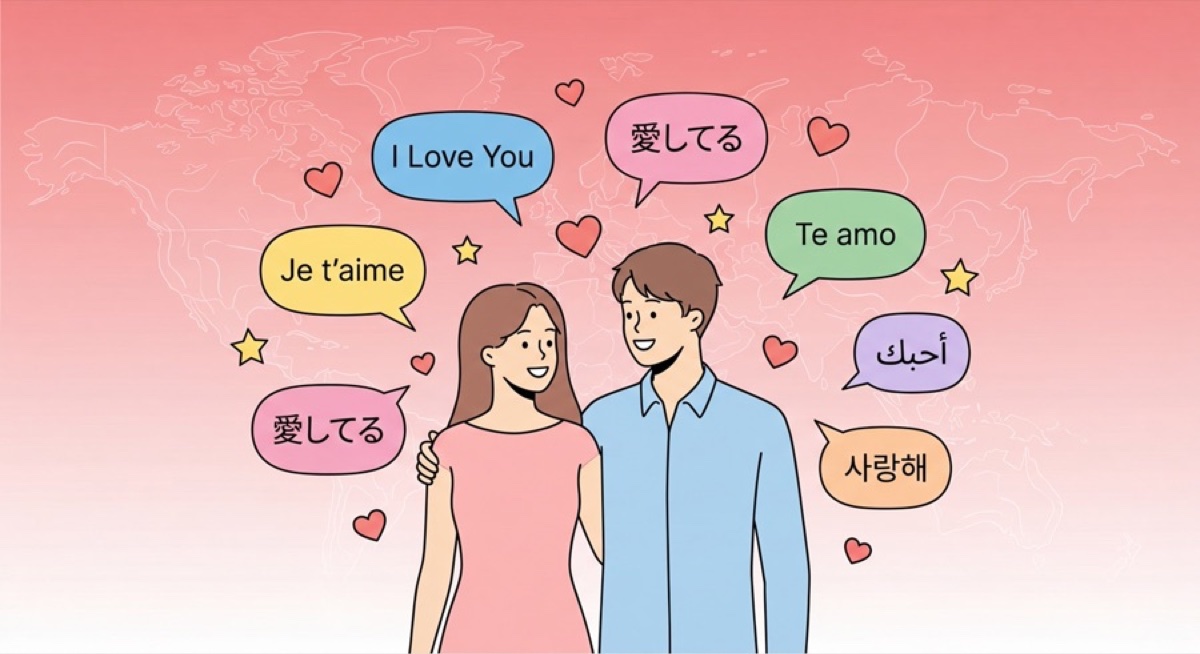
Why Language and Love Are Inseparable
Language is not just a tool for communication — it is the architecture of emotion. The words a culture chooses for love reveal what that culture values most: passion, loyalty, devotion, or quiet constancy. When you say "I love you" in someone's native tongue, you are not merely translating a phrase. You are stepping into their world.
English speakers often take for granted that three syllables can sum up one of the most complex human experiences. But in Japanese, the most powerful declaration of love — aishiteru — is so weighty it is rarely spoken aloud. In Arabic, poets have catalogued over thirty distinct words for love's many stages. In Portuguese, saudade captures a longing for love that English cannot even name. Every language is a different lens on the same luminous feeling.
This guide is your companion to love across languages and cultures. Whether you want to surprise a partner, connect with family roots, or simply satisfy your curiosity about how the world loves, you will find everything you need here — and links to tools that help you go deeper.
The Most Widely Spoken Languages of Love
With over 500 million native speakers, Spanish is one of the most important languages of love on Earth. The distinction between te amo and te quiero — one reserved for deep romantic love, the other for affectionate caring — gives Spanish speakers a nuance English entirely lacks. Dive into the full story in our guide to how to say "I love you" in Spanish.
French has long been crowned the language of romance, and for good reason: its flowing phonetics, its literary tradition, and its culture of emotional restraint all conspire to make every je t'aime feel earned. Mandarin Chinese, Arabic, Hindi, and Portuguese round out the languages spoken by billions of people who have their own exquisite ways of naming love. Our Say "I Love You" translator covers 60+ languages so you can hear and read them all.
Languages With Unique Emotional Depth
Some languages have developed vocabulary for love that leaves English standing in the shallows. Korean culture has built an entire calendar of romantic milestones — the 100-day anniversary is a genuine celebration — and its language reflects that emotional precision. Learn more in our article on how to say "I love you" in Korean.
German offers perhaps the most surprising case: a culture often stereotyped as emotionally reserved has produced a declaration — Ich liebe dich — that carries enormous gravity precisely because it is used so sparingly. And Italian, with its twin expressions ti amo and ti voglio bene, distinguishes between passionate romantic love and a deep, familial tenderness that English collapses into a single word. Explore all these distinctions in our guide to untranslatable words for love.
How Culture Shapes the Way We Say "I Love You"
Across cultures, the way love is expressed often matters as much as the words themselves. In many East Asian cultures, love is demonstrated through acts — preparing food, showing up reliably, sacrificing comfort — rather than verbal declarations. In Middle Eastern poetic traditions, love is exalted in elaborate metaphor stretching back thousands of years. In Latin cultures, physical warmth and vocal expressiveness are the natural currency of affection.
These differences are not deficits in any direction — they are variations in a universal human song. Understanding them makes us better partners, better travelers, and better human beings. Our full exploration of how different cultures express love digs into the East-West divide, acts of service traditions, and the fascinating science behind verbal versus non-verbal love.
If you want to know which languages are considered most romantic — and why linguists and lovers disagree on the answer — our article on the most romantic languages in the world makes the case for some surprising contenders alongside the obvious favorites.
Tools to Help You Express Love Across Languages
Knowing how to say "I love you" is just the beginning. Our Say "I Love You" translator lets you hear authentic pronunciations in over 60 languages, so you can say it right — not just spell it. For a more personal touch, the Love Poem Generator crafts original poetry you can dedicate to someone special, while the Love Letter Generator helps you put your deepest feelings into words when your own words fall short.
Need daily inspiration? The Love Fortune Cookie delivers a new romantic insight every day, and our curated collection of Love Quotes draws on the world's great writers, poets, and philosophers to remind you that the need to name love is as old as language itself. Every tool on Love.You exists to help you bridge the distance between what you feel and what you say.
A Journey Worth Taking
Learning to say "I love you" in another language is one of the most intimate gifts you can offer another person. It says: I cared enough to learn your world. It says: your culture matters to me. It says what words in any language sometimes struggle to say — that you see someone, fully, and choose them anyway.
Use this hub as your starting point. Each spoke article below goes deep on a specific language or cultural theme, giving you the history, the pronunciation tips, the cultural do's and don'ts, and the emotional context that transforms a phrase into a genuine connection. Love is the most universal human experience. Language is how we reach across the space between us to share it.