Ana Uhibbak: The Core Declaration
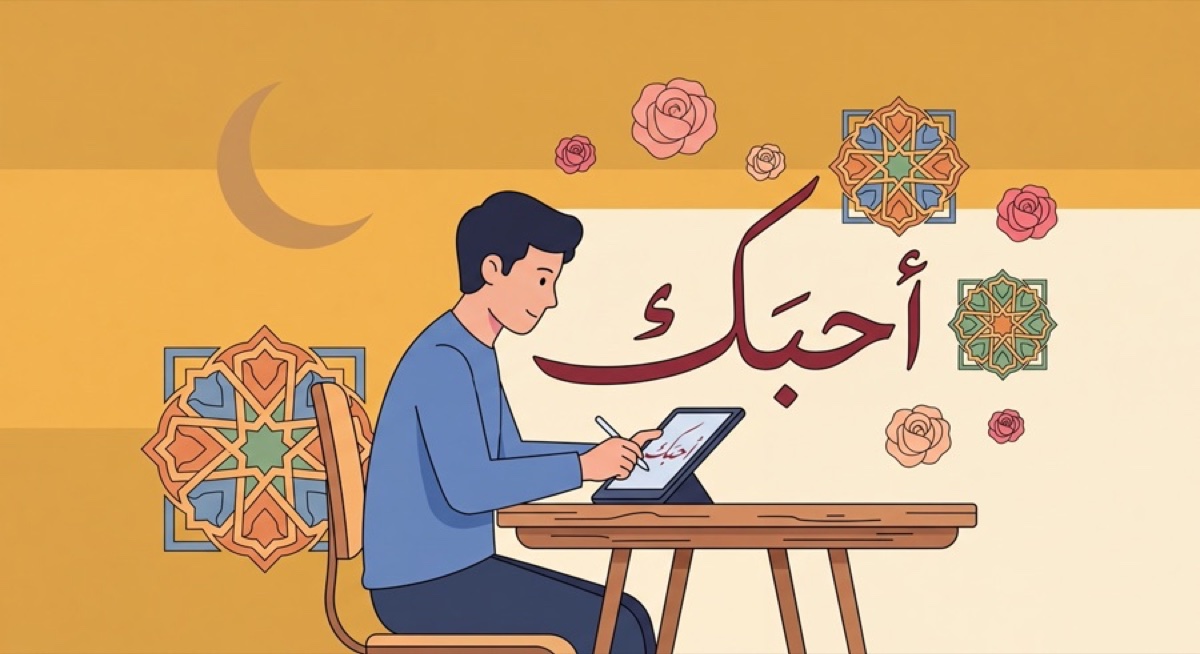
The standard Arabic phrase for "I love you" is ana uhibbak (أنا أحبك) when said to a man, or ana uhibbik (أنا أحبكِ) when said to a woman. Arabic is a grammatically gendered language, and the second-person pronoun changes depending on who you are speaking to. The word uhibb comes from the root h-b-b, which carries connotations of warmth, closeness, and affection — it is the most common Arabic word for love and the one you will encounter most frequently in everyday speech.
In Modern Standard Arabic (the formal written and broadcast language used across the Arab world), this is the universal form. But in spoken dialects, the phrase changes considerably by region. In Egyptian Arabic, one of the most widely understood dialects due to Egypt's cultural influence through film and television, "I love you" is ana bahibbak (to a man) or ana bahibbik (to a woman). In Levantine Arabic (spoken in Lebanon, Syria, Jordan, and Palestine), the form is similar. In Gulf Arabic, you might hear ana ahibbak. Each dialect has its own music and rhythm. Use our Say "I Love You" translator to hear authentic pronunciations.
The Thirty Stages of Arabic Love
Classical Arabic scholars, particularly in the medieval Islamic golden age, undertook the remarkable project of cataloguing every stage and variety of love, assigning each a specific word. Ibn Hazm, the 11th-century Andalusian scholar, wrote The Ring of the Dove, a treatise on love that remains one of the world's great romantic texts. Medieval Arabic grammarians identified as many as 50 words for love in various stages, though 30 is the number most frequently cited. A few of the most beautiful and evocative:
Hawa (هوى) is the very first inclination toward someone — attraction, the falling. Alaaqa (علاقة) is when the heart becomes attached. Kalaf (كلف) is passionate infatuation. Ishq (عشق) is deep, consuming love that borders on obsession — it is the love of poetry and song, intense and all-encompassing. Shaghaf (شغف) is a love that pierces the heart, entering the very lining of it. Tayam (تيّم) is to be enslaved by love. And walah (وله) is the bewilderment of love — the state of being so lost in feeling that the mind goes hazy. This taxonomy of love is itself a love letter to the emotion.
Ya'aburnee and Other Untranslatable Arabic Expressions of Love
Some of the most beautiful expressions of love in Arabic resist translation entirely. Ya'aburnee (يعبرني) is perhaps the most famous of these — it translates literally as "may you bury me," meaning "I love you so much I hope I die before you so I never have to live without you." Said from parent to child, between spouses, between deep friends, it is a declaration of love through the willingness to face death first. There is no equivalent in English, and no phrase quite captures the same depth of devoted love.
Rouh albi (روح قلبي) means "soul of my heart" — a term of endearment that layers soul and heart together in the one beloved. Hayati (حياتي) means "my life," and is used as a term of endearment across the Arab world. Eini (عيني) means "my eye" — suggesting that the beloved is as precious and irreplaceable as one's own sight. These are not hyperbolic; they are the natural idioms of a language that has always taken love seriously. Our article on untranslatable words for love explores ya'aburnee and other such gems from around the world.
The Arabic Poetic Tradition: Love as the Highest Art
The Arabic poetic tradition stretches back over 1,500 years, and love has always been its central subject. The pre-Islamic qasida tradition included the nasib — an elegiac opening section lamenting lost love — as a near-mandatory feature. The great classical poets like Imru' al-Qays, Al-Mutanabbi, and later Abu Nuwas wrote love poetry that remains deeply embedded in Arabic cultural memory. Schoolchildren across the Arab world still memorize verses about love written over a millennium ago.
The tradition of ghazal poetry — short, intense lyric poems focused on love — was developed in Arabic before being adopted by Persian, Urdu, and other literary traditions. The Andalusian Arab poet Ibn Zaydun, writing in the 11th century, produced love poems for his beloved Wallada that are still read and quoted today. Love, in the Arabic literary tradition, is not a frivolous subject — it is the deepest and most worthy subject of the poet's art. This tradition lives in the language itself, giving Arabic love expressions an inherent literary quality.
Regional Variations: How Love Sounds Across the Arab World
The Arab world stretches from Morocco in the west to the Arabian Gulf in the east, and the Arabic spoken across this vast geography varies considerably. In Morocco (Moroccan Darija), "I love you" is kanbghik, a form so different from Classical Arabic that speakers from the Gulf might struggle to recognize it. In Iraqi Arabic, ahibbich is the form for addressing a woman. In Yemeni dialect, the word for love takes yet another form. This variation is part of what makes Arabic so fascinating: it is simultaneously one language with a shared literary heritage and dozens of living dialects with their own distinct personalities.
What unites these regional varieties is a shared cultural value: love in the Arab world is frequently expressed with intensity and poetry, regardless of dialect. Compliments are elaborate; terms of endearment are layered; the rhetoric of love in everyday speech tends toward the elevated rather than the understated. Even in casual text messages between young Arabic speakers, you might find phrases that would read as high poetry in any other culture. For more on regional and cultural variation in love language, see our article on how different cultures express love.
Islamic Context and Love: Mahabbah and Spiritual Dimensions
In Islamic theology, love — mahabbah (محبة) — is one of the highest spiritual states, a concept that applies both to human love and to the love between the believer and God. The Sufi tradition, in particular, developed an elaborate mystical vocabulary of love, using the language of human romance as a metaphor for divine love. Rumi's poetry — originally written in Persian but deeply indebted to Arabic mystical tradition — is saturated with this divine-human love language. His images of the moth and the flame, the lover and the beloved, work on multiple levels simultaneously.
This spiritual dimension gives Arabic love language a depth that is hard to separate from the cultural context. When an Arab person uses mahabbah, they may be touching on resonances that extend well beyond the romantic. Love, in this tradition, is not diminished by being human — it is elevated by being a reflection of something cosmic. The language of love and the language of the sacred intertwine in Arabic in ways that have no parallel in secular Western romanticism.
Practical Guide: Using Arabic Love Phrases
If you want to express love in Arabic, start with the basics and let the recipient's dialect guide you. If you know someone is Egyptian, learn the Egyptian form; if they are Lebanese, learn the Levantine. This specificity shows genuine care and cultural attentiveness. For a beautiful term of endearment, hayati (my life) is understood and loved across dialects. Amar (moon, قمر) is used as an endearment — calling someone "my moon" — throughout the Arab world.
For written expressions of love, Arabic script itself is beautiful and calligraphic — a handwritten love note in Arabic, even imperfect, is a meaningful gesture. Our Love Letter Generator can help you craft the content, and our Love Poem Generator offers poetic options. For pronunciation of all the key phrases, use our Say "I Love You" translator. And to understand how Arabic love language fits into the global picture, visit our hub on saying "I love you" in every language.