Why Finding Your Partner's Language Matters
You can love someone deeply and still fail to make them feel loved, simply because you're expressing love in a language they can't fully receive. Understanding the 5 love languages gives you a framework for this, but only if you can correctly identify which language your partner speaks. Getting this right transforms the way you direct your love — instead of scattering effort across all five languages hoping something lands, you can focus on the one or two that genuinely matter most to them.
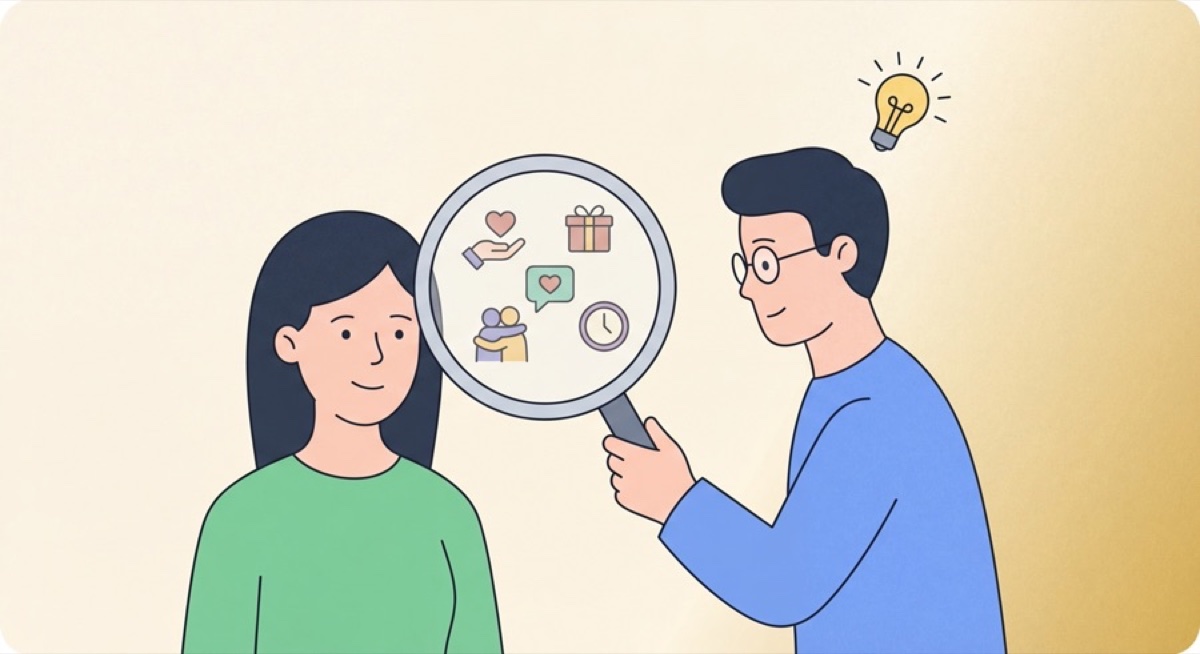
The good news is that your partner is almost certainly already communicating their love language to you, every day. You just need to know what to look for. Three channels reveal a person's love language most reliably: what they complain about, what they request, and how they express love to others. Paying attention to these three things will tell you almost everything you need to know.
Observation Method 1: What Do They Complain About?
Complaints are love language signals in disguise. When someone says "You're always on your phone when we're together," they're revealing a Quality Time love language. "You never tell me you appreciate me" points to Words of Affirmation. "You always forget things that are important to me" may point to Receiving Gifts. "I feel like I'm doing everything around here" often signals Acts of Service. "You never reach for my hand anymore" is a Physical Touch signal.
This isn't about treating every complaint as a data point to be analysed clinically. It's about genuinely listening to what your partner is missing and connecting it to the framework of love languages. The next time your partner expresses a recurring frustration, rather than becoming defensive, ask yourself: what love language might this be pointing to? What are they actually asking for, beneath the surface of the complaint?
Observation Method 2: What Do They Request?
Another reliable signal is what your partner explicitly asks for. Someone who frequently says "Can we just sit together without looking at our phones?" is speaking Quality Time. Someone who asks for back rubs, initiates hugs, or says "Can you sit closer to me?" is speaking Physical Touch. Someone who says "It would mean so much if you did X" and X is a practical task is speaking Acts of Service. Someone who lights up at a handwritten card or a small unexpected gift is showing you their Gifts language.
The requests don't have to be about love explicitly. Pay attention to the things your partner asks for in daily life — the specific things that seem to matter most to them and that they return to repeatedly. These requests are a map of their emotional needs, and love languages are the legend.
Observation Method 3: How Do They Love You?
People tend to give love in the language they most want to receive. This is an imperfect heuristic — some people learn early to suppress their natural language — but it's surprisingly reliable. The partner who is always writing little notes, leaving encouraging texts, and telling you what they appreciate about you is almost certainly Words of Affirmation. The one who is always handling tasks without being asked, anticipating your needs, and doing things to make your life easier is speaking Acts of Service. The partner who is always initiating physical contact, reaching for your hand, pulling you close, is speaking Physical Touch.
Watch what your partner does for you with love, and you'll often see a clear pattern. This also has a beautiful implication: when they do something in their love language for you, it may be their way of showing you what they want in return. If your partner frequently brings you small gifts and treats, they're probably not just being generous — they're also quietly telling you that gifts mean love to them.
Conversation Starters to Discover Their Language
Sometimes the most direct path is the best one: ask your partner. You don't need to make it academic or heavy. Here are some natural conversation starters that can open up the love language conversation:
"What's something I do that makes you feel really loved?" — This often surfaces their primary language directly. "When do you feel most connected to me?" — Quality Time people will describe shared moments; Physical Touch people will describe physical closeness; Words people will quote something you said. "Is there anything you wish I did more of?" — This can surface unmet love language needs gently. "What does feeling loved actually feel like to you? Like, what does your day look like when you feel really loved?" — This open-ended question often produces very revealing answers. Also use our Questions for Couples tool for a structured set of prompts that naturally surface this kind of information.
Using the Quiz
The most direct method is simply asking your partner to take the Love Language Quiz. If they've never heard of love languages, you can introduce it lightly: "I came across this quiz that reveals how you most feel loved — want to do it together? I'm curious." Most people find the concept immediately intuitive and the quiz results surprisingly accurate.
When you take it together, make it a conversation rather than a reveal. Share your results, discuss whether they feel accurate, and explore the nuances together. A person's primary love language might surprise both of you — sometimes people discover that a language they'd never consciously identified as important turns out to account for a significant source of disconnection in the relationship. The quiz is best used as a starting point for a conversation, not the final word. People contain more complexity than any framework can fully capture, and the real insight comes from the dialogue it opens up.
What to Do Once You Know
Once you've identified your partner's love language — through observation, conversation, or the quiz — the next step is making a genuine, consistent effort to speak it. Not perfectly, not dramatically, but regularly. If their language is Acts of Service, identify two or three specific recurring acts you can build into your routine. If it's Words of Affirmation, set an intention to say one specific, sincere affirming thing each day. If it's Quality Time, protect one phone-free ritual in your week, however small.
Share what you've learned with your partner, and ask them to share theirs with you. Make it mutual. Then revisit it — love languages are not static, and what fills your partner's tank in one season may shift in another. The real gift of the love languages framework isn't the discovery of a single answer — it's the ongoing practice of staying curious about how to love your specific person well. Explore each language in more depth through the hub articles, starting with whichever resonates most: Words of Affirmation, Acts of Service, Quality Time, Physical Touch, or Receiving Gifts.