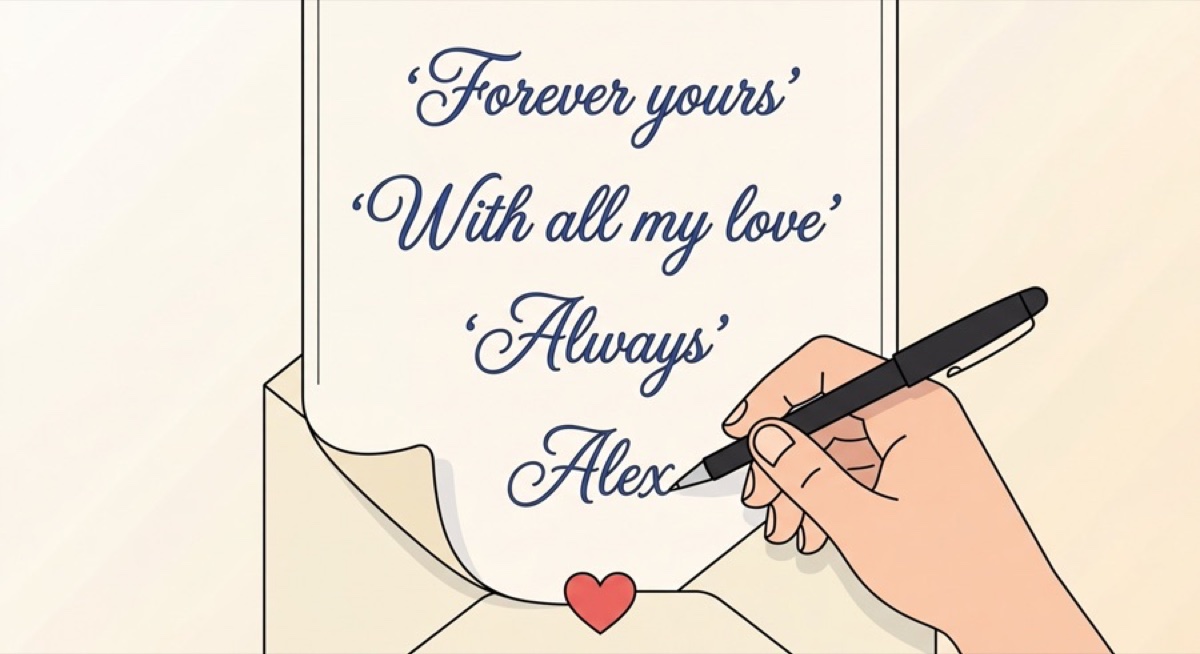
Why the Closing Matters So Much
In literary criticism there is a concept called "the closing image" — the final moment of a poem or story that the reader carries out of the text with them. Love letters work the same way. Your reader will finish the letter, fold it, set it down, and the last thing they read will linger in a way that nothing from the middle of the letter will.
Most people, however, give the closing almost no thought. They write the letter, arrive at the end of their thoughts, and default to "Love, [name]." This is not a bad closing — it is just thin. It is the punctuation mark of a letter that deserved a real conclusion.
A strong closing does two things: it resolves the emotional arc of the letter, and it leaves the reader with something — a feeling, an image, a thought — that will stay with them. That combination of resolution and lingering is what separates a good closing from a great one.
Alternatives to "Love," That Actually Work
These sign-offs are not just alternatives for variety's sake — each one carries a different emotional register. Choose the one that fits what has come before:
- Warmth and devotion: "All of it, always —" / "Everything I have —" / "Completely yours —" / "With all of this —"
- Playful and intimate: "Still yours, despite everything —" / "Hopelessly, as ever —" / "Yours and yours alone (you know the terms) —"
- Quiet and certain: "Steadily —" / "Constantly —" / "As ever —" / "Without condition —"
- Long-distance or longing: "Counting down —" / "Across however many miles —" / "Bridging the gap —" / "On my way to you —"
- New relationship: "Hopefully, nervously —" / "With my honest heart —" / "Taking the risk —"
- For profound occasions: "For keeps —" / "Irreversibly —" / "In all possible ways —"
A dash rather than a comma after the closing phrase subtly suggests continuity — it says the letter is not quite finished, that there is more where this came from. It is a small typographical choice with an emotional effect.
The Final Paragraph: Resolution Before Sign-Off
Before the sign-off, there is the final paragraph — often the most neglected part of a love letter. Many writers, having said everything they wanted to say, simply stop. The letter ends not because it has arrived somewhere but because the writer ran out of things to write.
A better approach is to write a final paragraph that deliberately brings the letter to a landing. There are several reliable ways to do this:
- Return to the opening image: If you opened with a memory or a specific detail, come back to it in the closing. The circularity creates a sense of completion. "I started by telling you about that Tuesday. I want to end there too — because it is still the image I return to when I want to remember what it feels like to be exactly where I want to be."
- Make a commitment: Not a grand vow, but a specific, concrete forward-looking promise. "I will tell you this more often. That is the commitment this letter is making."
- Name the moment: Acknowledge that you are choosing to write this, now, as a deliberate act. "I am writing this because I do not want to assume you know. I want there to be a record."
- Land on a single, plain truth: After everything else, the simple, unadorned thing. "I love you. That is the whole of it. The rest is just the evidence."
Matching the Closing to the Tone of the Letter
A playful, warm letter should not end with a grave, solemn closing. A serious, emotionally complex letter should not end with a breezy sign-off. The closing must be in conversation with everything that came before it — the same voice, the same emotional register, just arriving rather than continuing.
Read your letter back before writing the closing. Ask: what note is this letter ending on? What feeling has it been building toward? The closing should inhabit and confirm that feeling, not introduce a new one.
If your letter has been funny and warm, a closing like "Irreversibly yours — [name]" works beautifully because it carries a slight gravity that anchors the warmth. If your letter has been tender and serious, "All of it, always —" is appropriately quiet. If your letter has been raw and honest, ending with plain language — "I love you. That is everything." — is the right choice.
The Postscript: Using P.S. Well
A postscript, used well, can be one of the most memorable parts of a love letter. Its function is precisely its apparent informality — the P.S. signals "I thought of one more thing," which creates the illusion of spontaneity and adds warmth after the formal conclusion.
The best postscripts are either:
- Something small and loving that did not fit in the body of the letter but that you did not want to leave out
- Something slightly lighter in tone than the rest of the letter — a moment of humour or affection that lands differently after the more serious content
- The one thing you almost did not say — the most vulnerable sentence in the letter, which lands harder in a P.S. because of its apparent afterthought status
P.S. "I almost didn't send this." is more powerful at the end of a vulnerable letter than it would be anywhere else. P.S. "Also, I think about your laugh approximately forty times a day." is the right note of levity after a tender letter. Use the P.S. deliberately — as a final gift rather than an afterthought.
Common Closing Mistakes to Avoid
These patterns undermine an otherwise strong letter in its final moments:
- Apologising at the end: "I hope this makes sense" or "Sorry if this is too much" withdraw the letter's emotional offering at the exact moment it should be given fully. Never apologise for your love letter in the letter itself.
- Summarising: "So anyway, I just wanted to say that I love you and you mean a lot to me." The letter has already said this. A closing that summarises the letter is the prose equivalent of repeating a punchline.
- Making it about the response: "I hope you feel the same way" or "Let me know what you think" shift the emotional weight from giving to asking. A love letter is a gift, not a negotiation. End it as a gift.
- Going on too long: Know when you have arrived. The closing is a moment of stillness — do not fill it with more content. If you find yourself adding another paragraph after you thought you had finished, ask whether it is actually necessary or whether you are just reluctant to stop.
For the opening equivalent of these lessons, see our article on how to start a love letter. For complete examples of full letters including their closings, visit our love letter examples page.
20 Memorable Closing Lines You Can Adapt
These are complete final sentences — not sign-offs but the last sentence of the letter body before the sign-off. Use them as templates:
- "That is the whole of it. Everything else is just the evidence."
- "I did not know, when this started, that it would become the most important thing in my life. I know now."
- "I hope this finds you well, and I hope you know that 'well' is something I will always be working to help you be."
- "Come home soon. I have been keeping a list of things to tell you."
- "You are the life I did not know I was waiting for."
- "I love you the way you love a song that gets better every time you hear it."
- "However long we have, I will spend it being glad it was you."
- "There is no version of any of this that I would trade."
- "Thank you for being worth every word of this."
- "I will keep telling you. I will never assume you know."
- "The ordinary life we have built is extraordinary to me."
- "I am more myself with you than I have ever been with anyone."
- "Wherever you are reading this — I am glad this letter reached you."
- "You changed the mathematics of what I thought was possible."
- "I will see you soon. Until then, you have this."
- "The distance doesn't change the direction. I am always pointing toward you."
- "Stay. I am not done noticing things about you."
- "This letter will not say it as well as I could in person. But this letter will be here when I am not."
- "I love you quietly, consistently, and completely."
- "That is enough for now. That is everything, for now."
For help crafting the full letter around a closing like this, use our AI Love Letter Generator or read our complete guide on how to write a love letter.