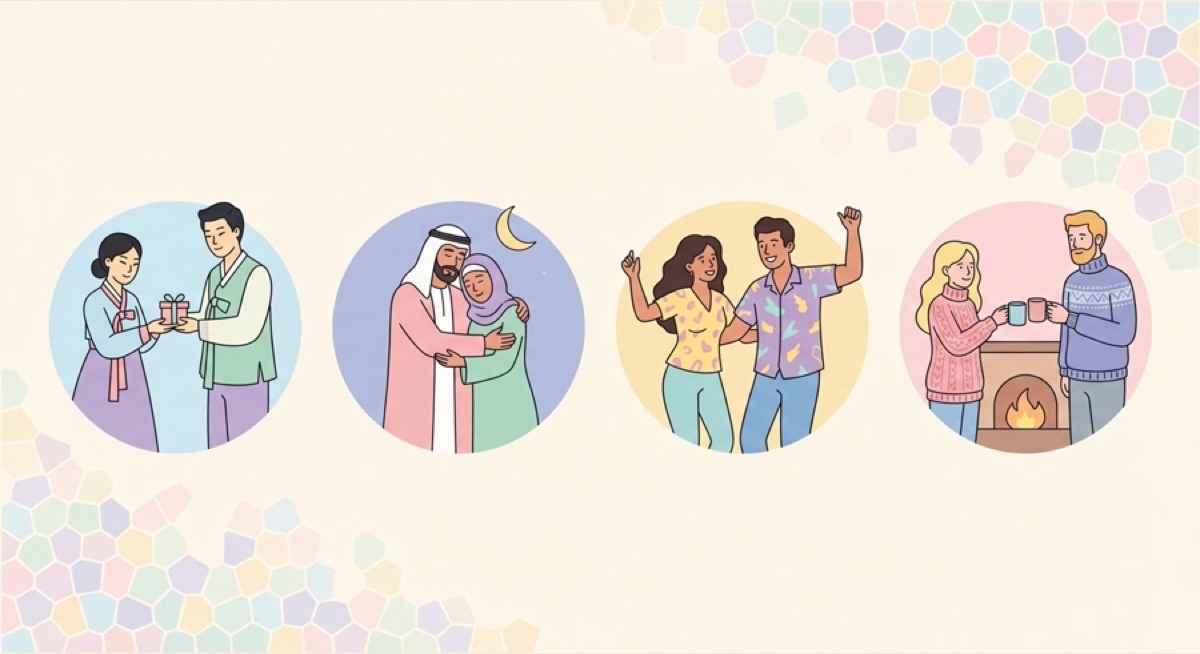
The Great Divide: Verbal vs. Non-Verbal Love Cultures
The most fundamental cultural divide in romantic expression is between cultures that prioritize verbal declaration and those that express love primarily through action. American culture sits at one extreme of the verbal end: "I love you" is said frequently, early, and often — in text messages, at the end of phone calls, as a casual warm sign-off between friends who have not seen each other in a while. The phrase is used so freely that it can lose some of its meaning, becoming more a marker of affection than a deliberate declaration of depth.
Many East Asian cultures — particularly Japan, China, and to a degree South Korea — sit closer to the action end of the spectrum. In these cultures, love is demonstrated through what you do: the food you prepare, the sacrifices you make, the consistency of your presence and support. Saying "I love you" daily might even seem slightly suspicious in these contexts — a sign that you are performing emotion rather than feeling it. This is not emotional absence; it is a different philosophy of how love should be communicated. The Japanese concept of omoiyari (anticipating a loved one's needs before they express them) is a love language of extraordinary sophistication. See our article on Japanese love language for more.
The Five Love Languages Through a Cultural Lens
Gary Chapman's "Five Love Languages" framework (words of affirmation, acts of service, receiving gifts, quality time, and physical touch) was developed primarily from the experiences of American couples — and it maps interestingly onto cultural patterns. Words of affirmation cultures (the United States, Brazil, many Latin cultures) place high value on verbal expression and affirmation. Acts of service cultures (Japan, China, Germany) prioritize what you do. Quality time cultures (many Mediterranean and Middle Eastern cultures, where hours spent together over food and conversation are the default) prioritize presence over productivity.
Physical touch cultures span much of Southern Europe, Latin America, the Middle East, and sub-Saharan Africa — places where physical proximity, touching during conversation, and physically affectionate greetings (kisses, embraces) are unremarkable and expected. Gift-giving cultures, which include Japan (with its elaborate tradition of omiyage — souvenirs brought back for loved ones) and many parts of East Asia and the Middle East, express love through the care and thoughtfulness of physical offerings. Understanding which love language a culture defaults to is the first step toward connecting with people from that culture on their own terms. For more on specific languages of love, our hub article links to individual language guides.
East Asia: Love as Care and Sacrifice
Across Chinese, Japanese, and Korean cultures, parental love is most readily expressed through sacrifice and provision — working long hours to provide for the family, ensuring the best possible education for children, placing the family's wellbeing above individual desires. Children raised in these cultures often describe feeling deeply loved without having heard the words spoken aloud regularly. The love is expressed in the structure of the family's life: in the food on the table, the sacrifices made for education, the parents' pride in the child's achievements.
Romantic love in these cultures follows similar patterns, modified by generational change and the influence of Western culture. South Korea has perhaps moved furthest toward verbal and demonstrative romantic expression — K-drama culture has normalized the explicit love declaration, the couple outfit, the anniversary celebration — while remaining distinctive in its specific rituals and milestones. China's younger urban generation is increasingly verbally expressive compared to previous generations, though still generally more reserved than American counterparts. Japan remains the most distinctive: even among young, urban Japanese couples, the daily "I love you" is unusual, but the daily act of thoughtful care is not. Learn more in our articles on Japanese and Korean love language.
The Middle East and South Asia: Love, Family, and Collective Romance
In many Middle Eastern and South Asian cultures, romantic love does not exist in the isolated dyad of the Western ideal — it exists within a web of family relationships that shape, approve, and sustain it. Marriage in these cultures is often a family matter as much as an individual one, which is not an absence of romance but a different container for it. The love between partners coexists with the love between families — and the approval and integration of the beloved into the family is itself an act of love, a welcoming-in.
Within relationships, many Middle Eastern cultures have a tradition of elaborate poetic expression of love that the West has largely lost. An educated Arabic speaker can draw on 1,500 years of love poetry to express what they feel; their vocabulary of the heart is richer than most. South Asian cultures, particularly those with Urdu and Persian literary heritage, have similar depths available to them. The ghazal tradition — love poetry of aching, indirect beauty — is a live tradition in South Asia, performed at concerts and heard on film soundtracks. Love in these cultures has a literary altitude that casual everyday expression in English rarely reaches. See our article on Arabic love language for more depth.
Latin Cultures: Love as Performance and Community
In Latin cultures — across Southern Europe and Latin America — love tends to be more public and more performance-oriented than in Northern Europe or East Asia. This is not performative in the pejorative sense; it is a genuine value placed on the visible expression of love as a social act. A couple that loves each other shows it: they dress well for each other, they hold hands in public, they greet each other with warmth even after a short separation. Love, in these cultures, is not a private matter — it is a contribution to the warmth and beauty of shared social life.
The family dimension is also crucial in Latin cultures. Familismo — the priority placed on family above nearly everything else — means that love for a partner is inseparable from integration into the family network. A partner who is good to your mother, who participates warmly at family gatherings, who is welcomed by the collective — this is a person who has been truly accepted. Conversely, a partner who holds themselves apart from the family is making a statement about where their love ends. Latin romantic culture is communal in a way that Northern European and American individualistic romance culture often is not. Explore our Spanish and Italian love language articles for more.
Northern Europe: Love as Respect and Equality
Scandinavian and Northern European romantic cultures have their own distinctive character, shaped by values of equality, individuality, and mutual respect. The Scandinavian countries consistently rank at the top of global surveys on gender equality — and this equality extends into romantic relationships. Romantic expression tends to be more measured and less performative than in Mediterranean or Latin cultures, but it is underpinned by a genuine respect for the partner's autonomy and individuality that is itself a form of love.
The Danish concept of hygge — cozy, warm togetherness, the pleasure of intimate shared time — is perhaps the most celebrated Northern European contribution to love culture. A hygge evening at home: candles, warm drinks, comfortable proximity, unhurried conversation — is an expression of love through the creation of shared comfort and peace. This is love as sanctuary, love as a space of safety created deliberately for the person you care about. It lacks the drama of Latin passion or the poetry of Arabic longing, but it has a steadiness and warmth that many people find more sustaining than either. Our article on German love language covers closely related cultural ground.
What We Can Learn From Each Other
The most useful thing about understanding cultural differences in love expression is not finding the "best" culture — it is expanding your own repertoire. If you have grown up in a verbally expressive love culture, you might experiment with the Japanese practice of acting love more and saying it less — noticing what deliberate, specific care does for your relationships. If you have grown up in an acts-of-service culture, you might try the Italian practice of verbal expressiveness — discovering what it does for your partner to hear love named aloud, even when they already feel it.
Love is not culturally fixed — it is culturally learned, which means it can be culturally expanded. The most loving people are often those who have crossed cultural lines in love, who have learned from partners of different backgrounds that there are more ways to say "I love you" than they ever imagined. For tools to help you express love across languages, use our Say "I Love You" translator. For inspiration from the world's greatest lovers and thinkers, browse our Love Quotes. And for the full picture of love across languages, return to our hub on how to say "I love you" in every language.