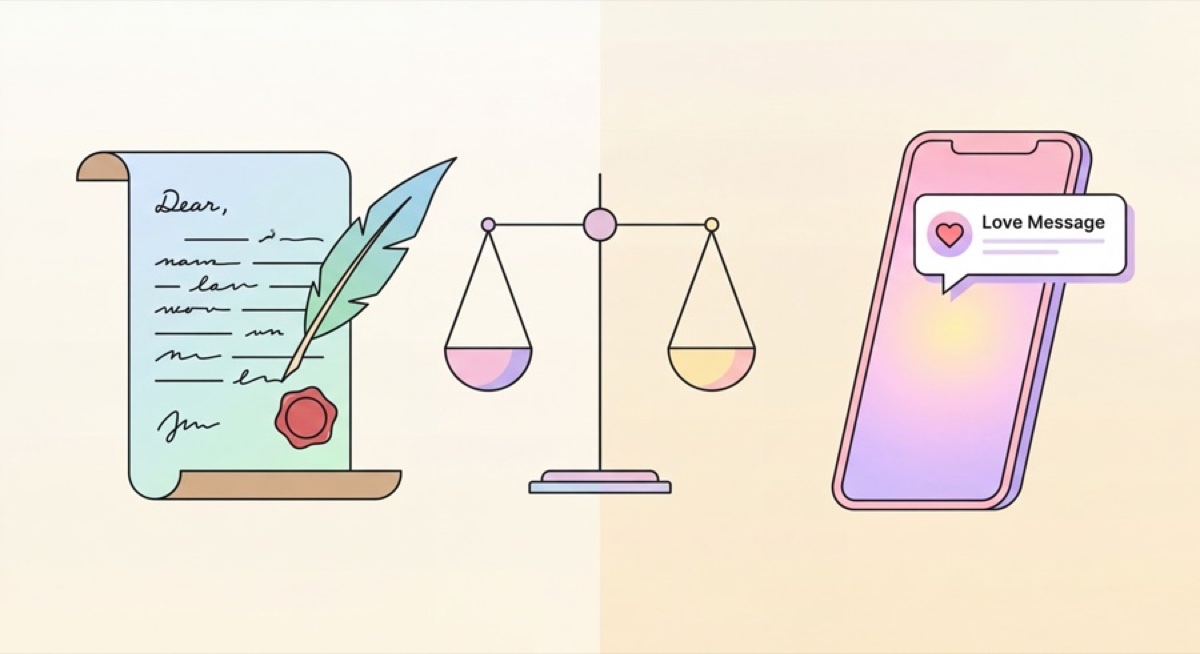
Why Format Matters More Than You Think
A love letter and the medium it arrives in are not separable in the way that content and container are in most communication. The physicality of a handwritten letter — its weight, the visible pressure of the pen, the slight imperfections of human handwriting — is part of its message. It signals: I held this. I sat down and wrote this. My hand touched this paper before it reached you.
A digital message signals different things: immediacy, spontaneity, ease of transmission across distance. Neither is inherently superior. But the choice communicates something, and you should make it deliberately rather than by default.
The question is not "which is better?" but "which is right for this specific moment, this specific person, this specific relationship?"
The Case for Handwritten Letters
Handwritten letters have several qualities that digital formats cannot replicate:
- Physical permanence: A handwritten letter can be kept in a box, re-read twenty years later, found accidentally and read again with fresh eyes. It exists in the world. Digital messages live inside devices and platforms that may not survive the relationship.
- Slowing down: Writing by hand forces a different pace than typing. You cannot delete as easily. You commit to each word as you write it, which tends to produce more considered language.
- Uniqueness: No two people have the same handwriting. A handwritten letter from you is literally unlike anything else your partner has ever received. Handwriting is intimate in the way a voice is intimate — recognisable, irreplaceable.
- Ceremony: The envelope, the stamp, the act of opening — these rituals frame the reading experience in a way that elevates even ordinary content.
Handwritten letters are almost always the stronger choice for significant occasions: major anniversaries, proposals, profound apologies, letters intended to be kept.
The Case for Digital Love Letters
Digital formats have genuine advantages that should not be dismissed:
- Distance: When you are separated by geography, a digital letter — email, a long message sent through a thoughtful app, a PDF of a typed letter — can arrive within seconds. The timeliness can itself be emotional.
- Length without physical constraints: There is no limit to a typed letter. Some people find it easier to be more expansive when typing, and length, when it is good length, is a gift.
- Editing: Typing allows you to draft, revise, and refine before sending in a way that handwriting does not. For people who struggle to find the right words, this can produce a better letter.
- Accessibility: Some people have conditions — dyslexia, tremors, motor difficulties — that make handwriting genuinely hard. A beautifully typed and presented digital letter is not a compromise; it is appropriate.
- Searchability: A digital letter can be re-read on a phone at 2 a.m. during a hard week, without needing to find a physical box.
Digital is often the right choice for long-distance relationships (see our guide to long-distance love letters), time-sensitive occasions, or relationships where the person receiving is more comfortable with digital communication generally.
When Handwritten Wins — Almost Every Time
There are specific situations where the handwritten format is so much more powerful that choosing digital would be a meaningful missed opportunity:
- Proposals or near-proposals: A letter that accompanies or precedes a major commitment should be physical. It will be kept.
- Sympathy-adjacent love: Letters written during bereavement, serious illness, or other profound hardship carry more weight in physical form.
- The first love letter: The letter that starts the record of a relationship. Irreplaceable if it is handwritten.
- Letters intended to outlast you: Letters written to children, or to a partner, meant to be read at some future point. These must be physical.
- When the relationship is primarily physical and present: If you live together and see each other every day, an emailed love letter has a faintly odd quality. A handwritten note left on a pillow is the right version of that impulse.
The Hybrid Approach
Many people find that the ideal approach combines both formats. Write the letter by hand, then photograph or scan it and send it digitally — your partner gets the warmth of handwriting across distance, and the original letter can be given when you next meet. Alternatively, draft digitally to get the content right, then copy the final version by hand onto good paper.
Another hybrid approach: a long, typed digital letter for the substance, accompanied by a short handwritten card for the ceremony. The typed letter does the work; the handwritten card signals the occasion.
Some couples use digital for frequency and handwritten for significance — regular, lighter messages sent via text or email, with handwritten letters appearing only for major moments. This creates a meaningful distinction: when a physical letter arrives, the recipient knows before opening it that this one matters differently.
Presentation and Materials
If you choose handwritten, the materials matter more than people think. A love letter on a torn page from a spiral notebook signals something different from one written on a quality sheet of paper, in an envelope, perhaps with a wax seal. Neither is wrong — both are communicating something — but consider what you want the physical object to say.
Good-quality writing paper and a proper pen (not a ballpoint from a desk drawer) will improve the experience of writing and of receiving. You do not need expensive stationery, but you do need paper that feels like it was chosen. Similarly, using your partner's name on the envelope — written in full, your best handwriting — begins the letter before it is even opened.
For digital letters, presentation still matters: use a readable font, proper line spacing, and send as a properly laid-out email or document rather than a wall of text in a messaging app. Format signals whether you treated the writing as something worth presenting well.
Practical Tips for Both Formats
For handwritten letters:
- Draft the letter in pencil or on a separate sheet first. Do not start on good paper without a draft.
- Write slowly. Rushing produces rushed-looking handwriting, which undermines the effect.
- Do not worry about crossing things out — it shows real thought and is more personal than perfection.
- Store copies. Photograph it before sending.
For digital letters:
- Do not send via WhatsApp or SMS — use email, where the format allows for length and the arrival feels more considered.
- Write offline first (a notes app or word processor), then paste and send. Writing directly into a message box produces worse writing.
- Consider a PDF attachment — it separates the letter from the conversational noise of an inbox.
Whatever format you choose, the content is what will be remembered. For help with what to actually write, see our complete guide to writing a love letter or use the AI Love Letter Generator to create a personalised draft.