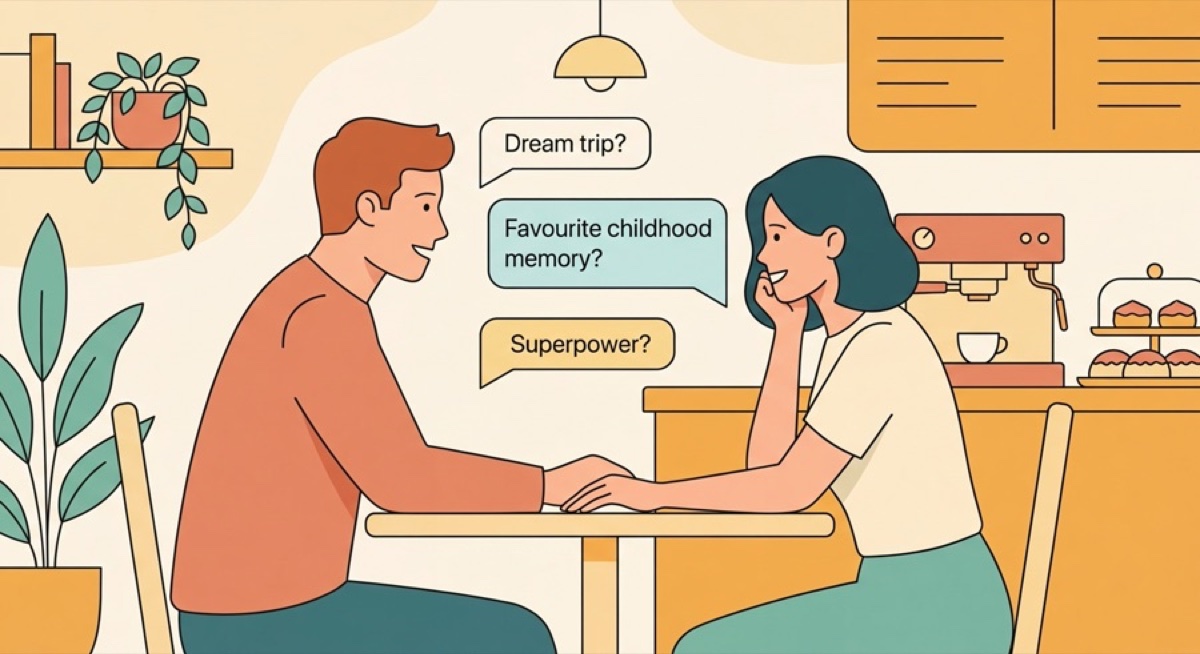
Why First Date Small Talk Fails
The standard first date conversation — "So, what do you do? How long have you been in [city]? Do you have siblings?" — is not wrong exactly, but it is thin. It establishes basic facts without creating any real sense of who the other person is. By the end of an evening built entirely on this kind of exchange, both people know each other's job titles and hometown but feel no closer to understanding what it would actually be like to know this person.
The research on interpersonal connection is clear: what generates genuine closeness is not the exchange of surface information but the sharing of values, vulnerabilities, and perspectives — the kind of conversation where you are genuinely surprised by what you learn, where you catch yourself thinking "I would not have expected that" in a good way. The questions below are designed to reach that territory without feeling heavy-handed.
Opening Questions That Actually Create Connection
The best first date opening questions share a quality: they invite a real answer rather than a rehearsed one. They are specific enough to require genuine thought but not so personal that they feel intrusive at a first meeting. Here are twenty that consistently produce real conversation:
1. "What has been the best part of your week, and the hardest?" 2. "Is there something you're really into right now that most people in your life don't care about?" 3. "What's something you've changed your mind about in the last few years?" 4. "Is there somewhere you've been that genuinely surprised you?" 5. "What's something you're looking forward to that isn't very far away?" 6. "What's a skill you've been slowly learning?" 7. "Is there a book, film, or podcast that's stayed with you?" 8. "What did you think you were going to be doing with your life when you were younger?" 9. "What's something that makes you laugh that probably only makes sense with context?" 10. "What's the best meal you've had recently, and where?"
11. "Is there something about your job that you actually love and rarely get to talk about?" 12. "What's a place you want to go that you haven't managed yet?" 13. "What's something you're genuinely proud of?" 14. "Are you someone who needs quiet time alone, or does being around people energise you?" 15. "What's something that you think is completely worth the expense?" 16. "If you could be extraordinarily good at one skill overnight, what would you choose?" 17. "Is there a piece of advice you were given that actually changed something for you?" 18. "What does a really good weekend look like for you?" 19. "What's the most interesting conversation you've had recently?" 20. "Is there something you do that most people would find surprising?"
Deeper Questions for When the Conversation Flows
Once the initial warmth is established and both people are genuinely engaged, you can move into territory that creates real intimacy. These are not questions to open with — they are questions to arrive at after the conversation has found its footing:
"What's something you think most people misunderstand about you?" — This question often produces surprisingly honest, revealing answers. "What does a life well-lived look like to you?" — You will learn a great deal about someone's values from how they answer this. "Is there something you care about deeply that you don't talk about much?" — This surfaces passions and commitments that casual conversation never reaches. "What's your relationship with where you grew up?" — This reveals how people relate to their history without asking a bland "where are you from?" "What do you find yourself doing when you're at your most comfortable?" — This is a gentle way of asking who they are when they're not performing for anyone.
What to Avoid on a First Date
As important as good questions is knowing what to leave out. The most common first date conversation mistakes: Talking at length about your ex — not because it is taboo, but because it signals that you are still emotionally located in the past relationship rather than the present conversation. Listing your credentials and accomplishments in a way that reads as an audition rather than an introduction. Asking questions and then not listening to the answers because you are already thinking about what to say next. Going too heavy too fast — grief, serious trauma, deep political disagreement — before rapport has been established. And, most critically, spending more time on your phone than on the person in front of you.
The goal of a first date is not to present the most impressive version of yourself. It is to have a conversation genuine enough that both people leave knowing something real about each other and wanting to know more.
Reading the Other Person: Signs It's Going Well
The clearest sign a first date is going well is time disappearing. Both people stop noticing the minutes because the conversation has become more interesting than the clock. Other good signs: they are asking you questions rather than waiting for their turn to talk; they are sharing things that are personal rather than keeping everything at a safe, public level; the humour is natural and mutual rather than performed; there are silences that feel comfortable rather than awkward. These are all signals that genuine interest has been established.
Signs it is not working are equally worth knowing: one person is doing most of the talking; the conversation keeps returning to logistics and facts without ever reaching feeling or perspective; questions are being answered minimally without elaboration; there is a sense of politeness rather than engagement. These do not mean the person is wrong for you — they may mean the questions you asked were not the right fit for them, or the setting was not comfortable, or the chemistry simply is not there. All of this is useful information.
After the Date: What Comes Next
If the date went well, the follow-up matters almost as much as the date itself. A message sent the same evening or the next morning — specific, warm, not desperate — sets the tone for what comes next. The best follow-up messages reference something from the actual conversation: "I've been thinking about what you said about [specific thing] — I think you're right." This proves you were genuinely present and that the conversation stayed with you.
If you want to suggest a second date, be direct rather than vague: "I'd love to see you again — are you free next week?" works far better than trailing off with "we should do this again sometime," which leaves both people uncertain whether a real invitation was made. For the second date and beyond, our Date Ideas tool generates options tailored to where you are in the relationship, and our Questions for Couples tool continues to deepen the conversation as things develop.