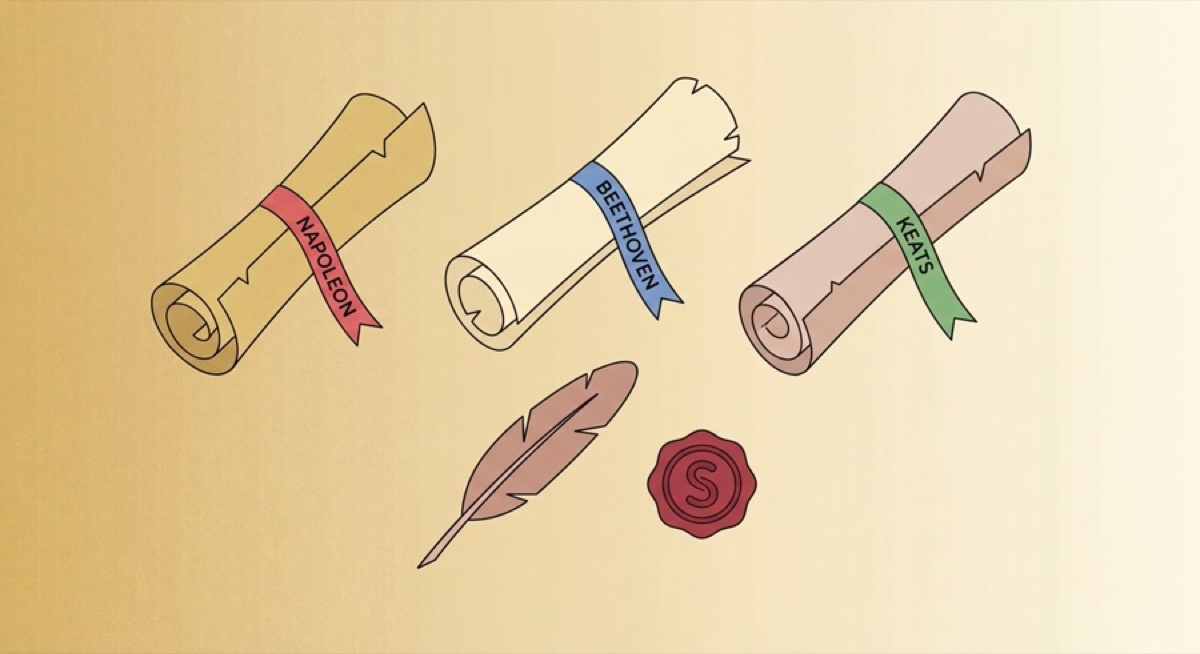
Napoleon Bonaparte to Joséphine (1796)
Napoleon is not usually associated with tenderness, but his letters to Joséphine de Beauharnais reveal a man completely undone by love. Written during his Italian campaign when he was separated from her for months, they are remarkable for their raw emotional urgency. One of the most famous lines reads:
"I wake filled with thoughts of you. Your portrait and the intoxicating evening which we spent yesterday have left my senses in turmoil. Sweet, incomparable Joséphine, what a strange effect you have on my heart!"
What makes these letters extraordinary is the vulnerability. Napoleon was at this point one of the most powerful military minds in Europe, commanding armies and reshaping nations — and here he is, writing essentially love-sick dispatches home, begging for letters in return, consumed by jealousy and longing. The contrast between his public persona and his private emotional state is what makes these letters feel so alive.
The lesson for your own letters: vulnerability is power. Admitting that you are undone by someone is not weakness — it is one of the most compelling things you can say.
Beethoven's Letter to His 'Immortal Beloved' (1812)
Found among Beethoven's possessions after his death, this unsent letter is one of the most haunting documents in the history of romantic correspondence. Its recipient has never been conclusively identified — candidates include Antonie Brentano and Josephine Brunsvik — which gives it an additional quality of mystery and longing.
"My angel, my all, my very self — only a few words today and at that with pencil (with yours) — not till tomorrow will my lodgings be definitively determined upon — what a useless waste of time... why this profound sorrow when necessity speaks — can our love endure except through sacrifices, through not demanding everything from one another?"
This letter is written in the broken, rushed grammar of genuine distress — Beethoven clearly did not compose it carefully. Its power comes from exactly that unpolished urgency. He is thinking aloud, addressing someone he loves and cannot reach, asking impossible questions about love and sacrifice.
The lesson: the polish of a love letter is not the same as its sincerity. Sometimes the most powerful thing you can do is let the seams show.
Johnny Cash to June Carter Cash (1994)
Written for June's 65th birthday, this letter is frequently cited as one of the most beautiful love letters of the 20th century. What is remarkable is its specific, domestic tenderness — it is not abstract. It is a letter about the particular texture of their life together.
"We get old and get used to each other. We think alike. We read each other's minds. We know what the other wants without asking. Sometimes we irritate each other a little bit. Maybe sometimes we take each other for granted. But once in a while, like today, I meditate on it and realize how lucky I am to share my life with the greatest woman I ever met."
This letter is a masterclass in long-term love letter writing. Cash acknowledges the irritations and the taking-for-granted without dwelling on them — he names them honestly and then pivots to the overwhelming positive. He uses the word "meditate," which is striking — this is a man who has stopped to think deliberately about his fortune. The letter ends with: "You still fascinate and inspire me. You influence me for the better. You're the object of my desire, the #1 Earthly reason for my existence."
The lesson: a long-term love letter does not need to pretend that everything is always perfect. Honesty about the ordinary friction of shared life makes the love that surrounds it more credible, not less.
F. Scott Fitzgerald to Zelda (1919)
F. Scott Fitzgerald wrote to Zelda Sayre before they were married, in a period of profound uncertainty — she had broken off their engagement, he was not yet successful, and the letters he wrote during this time are some of his most nakedly emotional writing. The famous passage:
"I love you and I'm going to love you until the stars give out and you are older than old queens — and I'm going to make you love me again."
Fitzgerald's letters to Zelda have a literary quality that is inseparable from who he was — he could not write without imagery, even in personal correspondence. But what makes these letters feel real rather than performed is the fear underneath the beauty. He was genuinely afraid of losing her, and that fear animates every ornate sentence.
The lesson: great love letter writers are not more talented at love — they are more willing to name what they are afraid of. Fear, named honestly, is one of the most intimate things you can share.
Virginia Woolf to Vita Sackville-West (1927)
Virginia Woolf's correspondence with Vita Sackville-West is voluminous and extraordinary. Woolf writes about love the way she writes about everything — as a series of precise, shimmering observations. One famous passage reads:
"I am reduced to a thing that wants Virginia. I composed a beautiful letter to you in the sleepless nightmare hours of the night, and it has all gone: I just miss you, in a quite simple desperate human way."
The self-awareness here is characteristic of Woolf — she composed the letter in her head and lost it, and now is left with the raw, simple thing underneath the beautiful language. That admission — "I just miss you, in a quite simple desperate human way" — is one of the most honest statements about longing ever written, made more powerful by coming after an acknowledgement of her own tendency toward linguistic excess.
The lesson: sometimes the most powerful sentence in a love letter is the one that strips away all the craft and says the plain thing. Earn the plain sentence with everything that comes before it.
What All Great Love Letters Have in Common
Across centuries, cultures, and wildly different personalities, the most celebrated love letters share a recognisable set of qualities:
- Specificity: The great letter writers do not deal in generalities. They name specific feelings, specific moments, specific qualities of the person they love.
- Vulnerability: Every great love letter exposes something the writer is genuinely afraid to expose. The risk is part of the message.
- Authentic voice: You can tell immediately that Napoleon's letters were written by Napoleon, Cash's by Cash. The voice is inseparable from the content. They did not write in an approximation of how a love letter should sound.
- Directness alongside complexity: The best letters can be both — ornate and plain, complex and simple, within the same letter. They know when to reach for imagery and when to state the thing flatly.
- They were written to be read, not admired: None of these writers were thinking about posterity. They were thinking about one person. That singular focus is what makes them, paradoxically, universal.
If you want to apply these lessons to your own writing, see our full guide on how to write a love letter, or let our AI Love Letter Generator help you create a personalised draft.
Reading Famous Letters as a Writer
The most useful way to read these letters is not as masterpieces to admire but as demonstrations of technique — specific moves you can study and adapt. Notice how Cash transitions from naming the ordinary frustrations of a long marriage into an overwhelming statement of love. Notice how Woolf earns her simplest sentence with everything she writes before it. Notice how Napoleon's vulnerability makes him more compelling, not less.
You do not have Napoleon's dramatic circumstances or Fitzgerald's literary gifts, but you have something they did not have: a real, specific relationship with a real, specific person. Your material is as rich as theirs. The job is to find the technique to match it.
For examples of complete love letters in the modern register, see our love letter examples page, which includes full letters for six different occasions. And if the blank page is your obstacle, our AI Love Letter Generator gives you a starting point to work from.