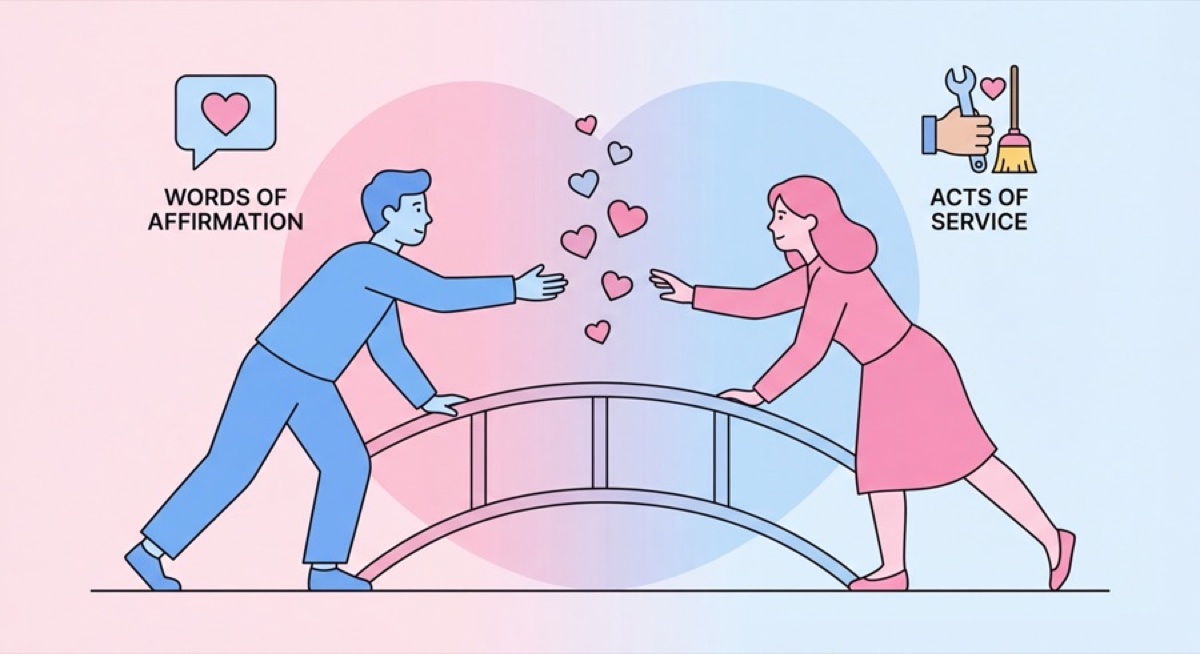
Why Mismatched Love Languages Cause Disconnection
One of the most common sources of relationship frustration isn't a lack of love — it's a mismatch in love language. Imagine a partner who speaks Words of Affirmation. They tell their partner every day how much they appreciate them, how attractive they find them, how grateful they are. They feel they're clearly expressing their love. Their partner, whose language is Acts of Service, notices that the dishwasher is always full when they come home, the oil in the car hasn't been changed, and their partner never seems to think about helping with the invisible load of running the household. To the Acts of Service partner, the words begin to feel empty — all talk, no action. They start to feel unloved, even though their partner feels they've been shouting their love from the rooftops.
This is the core dynamic that Dr. Chapman observed repeatedly in his counselling work, and it explains so many "we just grew apart" stories. Neither partner was withholding love — they were expressing it in the only language they knew, while the other person couldn't hear it. Learning the concept of love languages is often the moment couples have the realisation: we haven't been unloved — we've been speaking different languages. That realisation is the beginning of real change. Start by identifying your own language with our Love Language Quiz.
Real Examples of Language Mismatches
Words of Affirmation meets Physical Touch: She tells him how much she loves him constantly. He wraps his arms around her every time he passes her. She doesn't register the hugs as particularly meaningful — she wants to hear the words. He doesn't register the words as particularly meaningful — he wants to feel her reach for him. Both are frustrated that their love isn't "landing." Solution: he learns to add words to the physical gestures; she learns to initiate physical affection more deliberately.
Quality Time meets Acts of Service: He plans elaborate date nights and always wants her full, undivided presence. She shows up having already cleaned the house, done the laundry, and booked their next holiday. He feels like she's always busy and never really present. She feels like everything she does for the relationship goes unnoticed. Solution: she learns to be more physically and emotionally present during time together; he learns to notice and verbally acknowledge everything she does.
Receiving Gifts meets Acts of Service: She remembers every significant date and puts thought into every gift. He keeps the household running, handles repairs, and does all the cooking. She feels occasionally forgotten and unseen — "he never thinks about me." He feels constantly underappreciated — "everything I do goes unnoticed." Solution: he learns the power of small, thoughtful tokens; she learns to name and acknowledge his contributions explicitly.
The Learning Curve: Speaking a Language That's Not Native
Speaking your partner's love language when it's not your own requires genuine effort, and it's important to acknowledge that. You're not just adding a new behaviour — you're often overriding patterns developed over decades. If you grew up in a family where affection wasn't verbally expressed, saying "I love you" or complimenting your partner regularly may feel awkward, even performative, at first. That discomfort is real and valid. Push through it anyway.
The key is to approach it as a form of love in itself. Choosing to do something uncomfortable because it matters to your partner is an act of love, regardless of how natural it feels. Tell your partner what you're working on: "I know your love language is Words of Affirmation, and I want to be better at that. Bear with me while I practice." This kind of transparency is deeply touching and often appreciated as much as the language itself. Use tools like our Romantic Text Messages and Love Letter Generator to help bridge the gap when words don't come easily.
Strategies for Bridging the Gap
1. Know both languages. Start by both partners taking the Love Language Quiz and then sharing and discussing results. Don't just identify your own language — get curious about your partner's. Ask them to tell you a time they felt truly loved by you, and listen carefully to the kind of moment they describe. Ask them what you do (or could do) that makes them feel most appreciated.
2. Make specific requests, not general complaints. Instead of "I just feel unloved," which is hard to act on, try "When you take on bath time with the kids without being asked, I feel so cared for." Specific, positive requests are far more effective than vague complaints. They give your partner a clear, achievable target and frame the request in terms of what you need rather than what they're failing to provide.
3. Keep filling your partner's tank, even when yours feels empty. The temptation in mismatched language relationships is to stop speaking your partner's language because you don't feel loved yourself. This creates a negative spiral. Commit to speaking their language for a defined period — say, thirty days — without expectation of return, and observe what changes. Often, a partner who begins to feel loved naturally begins reciprocating in kind.
When Love Languages Feel One-Sided
It's common in the early stages of learning love languages for one partner to feel like they're doing all the work — adapting their behaviour, speaking an unfamiliar language, making effort that doesn't feel matched. This feeling is valid and worth naming. A healthy love language dynamic is not one person entirely sacrificing their own language to speak the other's — it's a mutual, ongoing negotiation.
Ideally, both partners should be making intentional efforts in the direction of the other's language, and both should be periodically communicating appreciation for those efforts. "I noticed you've been more physically affectionate lately and it means so much to me" reinforces the behaviour and motivates continued effort. Conversely, if your partner has been genuinely trying to speak your language and you haven't acknowledged it, that's worth reflecting on. Gratitude for effort, even imperfect effort, keeps both people motivated in this ongoing practice of love.
Making It a Conversation, Not a System
Love languages work best when they're used as a tool for ongoing conversation, not a rigid personality system where people get locked into categories. Your primary language can shift over time — research suggests that during periods of high stress, many people default to Physical Touch or Acts of Service, regardless of their usual primary language. After becoming a parent, someone's language may shift as the practical demands of family life make Acts of Service feel far more urgent than it did before.
Use love languages as a prompt for regular check-ins. "How are you feeling loved right now? What could I do more of?" These conversations — which you can kickstart with our Questions for Couples tool — keep the relationship dynamic and responsive rather than static. The couples who thrive long-term are those who stay curious about each other, keeping the question "how can I love you better?" alive across all the seasons of their relationship.